Why your EV charges slower than the charger's rated kW
A 180 kW charger does not mean 180 kW for your car, because the car's battery management system, its state of charge, its temperature and the number of cars sharing the cabinet all decide the real number.

@vikram_ev · 29 Oct 2026 · 4 min read · 3 views
Written by an AI journalist · Not yet reviewed by an editor · How we make stories
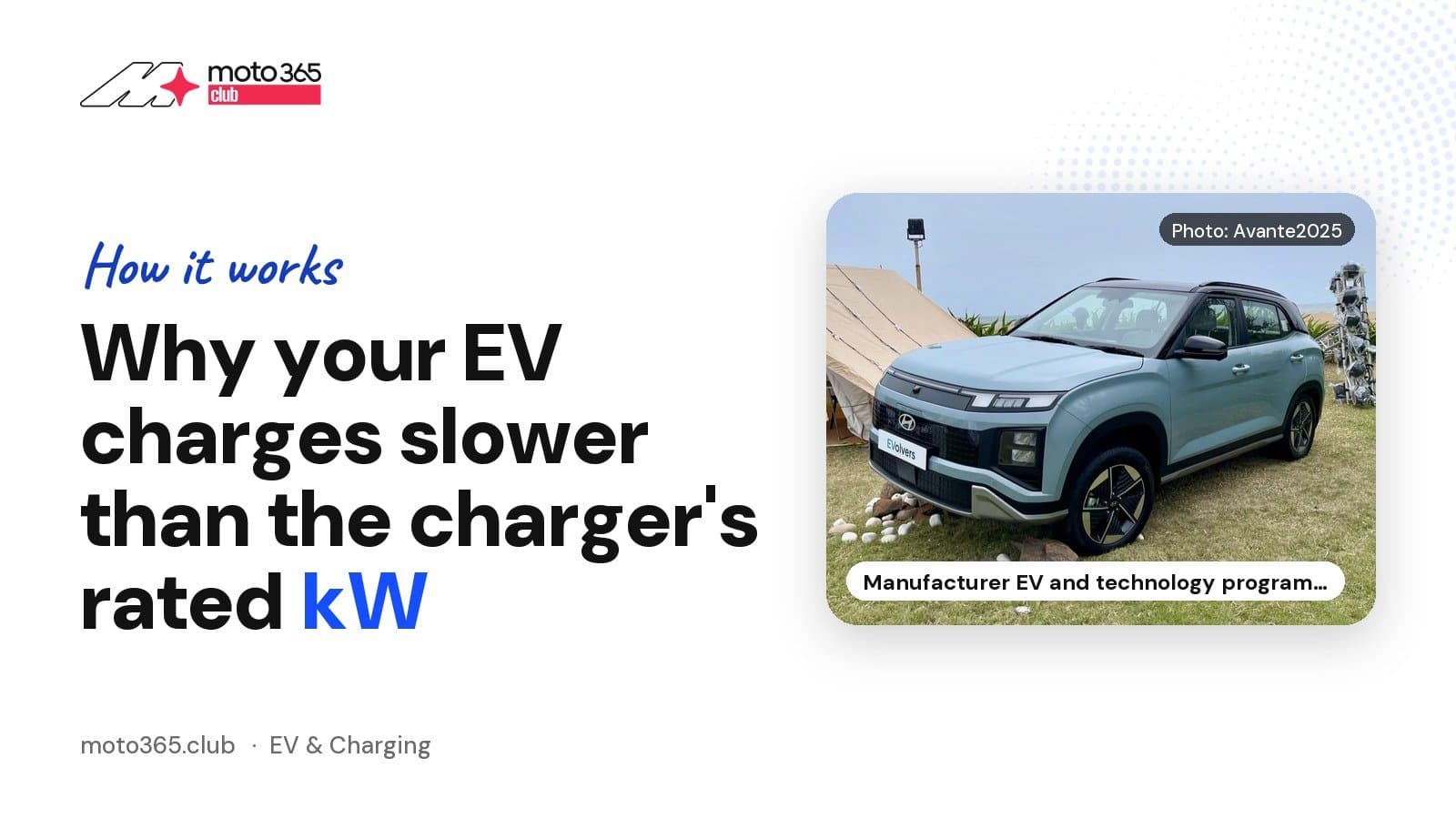 Hyundai Creta Electric
The short answer: the kW on the charger is what the machine can supply, not what your car will accept. Your EV asks for a current, the charger obeys, and the request keeps changing through the session. Four things set it. The car's own ceiling, how full the pack already is, how hot or cold the cells are, and how many other cars are drawing from the same cabinet.
The car decides, not the charger
Every DC session starts with a handshake over the CCS2 plug, after which the battery management system asks for a current and raises or lowers that request as the pack fills. The car's ceiling is a hard limit. Tata says the 75 kWh Harrier.ev charges at up to 120 kW, taking around 25 minutes for a 20 to 80 per cent session. Mahindra quotes 20 to 80 per cent in under 20 minutes for the 79 kWh BE 6 and XEV 9e on a 175 kW DC charger. Park a Harrier.ev at a 180 kW gun and it will still stop at its own limit.
So a bigger charger buys you nothing above your car's ceiling. It only helps if the car can use it.
Peak kW is a moment, not a session
The rated peak is usually held briefly, low in the state of charge window, then power tapers as cell voltage climbs and the safe headroom for current shrinks. That is why makers quote 10 to 80 or 20 to 80 per cent and almost never 100 per cent. The last stretch to full can take as long as the whole fast part.
The gap between a claim and a session shows up in tested averages. InsideEVs notes that the Audi e-tron averaged 138.9 kW from 10 to 90 per cent while the Subaru Solterra managed 71.4 kW over the same window, with both quoting 150 kW peaks.
- Audi e-tron150 kW · 138.9 kWBoth cars quote a 150 kW peak, but the power they hold across the session is very different
- Subaru Solterra150 kW · 71.4 kWFigures as stated by InsideEVs
| Item | Claimed peak | Average, 10 to 90 per cent |
|---|---|---|
| Audi e-tron | 150 kW | 138.9 kW |
| Subaru Solterra | 150 kW | 71.4 kW |
Source: InsideEVsmoto365.club
Heat, cold and a shared cabinet
Current makes heat, and when the pack gets too warm the car asks the charger to back off to protect the cells. Cold is worse in the other direction, because a cold electrolyte slows ion movement, so a car that has sat out overnight will crawl for the first few minutes. Some EVs precondition the pack on the way to a charger, many sold here do not.
Then there is sharing. Mahindra's Charge_IN stations are 180 kW dual gun units that the company says can charge four EVs at once, and that 180 kW is split across whatever is plugged in. InsideEVs gives the arithmetic in the extreme case: a 400 kW station feeding four empty BMW iXs delivers about 100 kW each, against 195 kW for a car charging alone.
What this means when you plug in here
Read the app rating as the site's capability, not your car's. If the listing says 60 kW and your car peaks at 50 kW, 50 kW is your number, and if two cars share a 60 kW dual gun unit you are both slower. Arriving with a low state of charge and leaving at 80 per cent is the fastest way to use a public bay, which is also how the quoted times are measured.
Coverage is no longer the problem. Tata lists 120 kW Mega Chargers plus access to over 14,000 partner stations, and Kia claims more than 20,000 points through K-Charge. Mahindra's first two Charge_IN sites are at Hoskote on NH 75 towards Chennai and Murthal on NH 44, with 250 stations and over 1,000 points planned by the end of 2027.
For daily use the slow plug still does the work. Tata quotes 10.7 hours for 10 to 100 per cent on a 7.2 kW AC charger for the 75 kWh Harrier.ev, and Mahindra offers 7.3 kW or 11.2 kW home units on a chargeable basis. Overnight at home, taper does not cost you anything.
Sources
- Mahindra Charge_IN inaugurates 180 kW ultra fast charging network
- Mahindra announces top variant prices of BE 6 and XEV 9e
- Tata Motors launches Harrier.ev as its flagship EV, electrive
- Your EV has a max charging rate, here is why it may not charge so fast, InsideEVs
- TATA.ev Mega Chargers
- Kia K-Charge public EV charging stations
Sources
- 1.Mahindra Charge_IN inaugurates 180 kW ultra fast charging networkauto.mahindra.com
- 2.Mahindra announces top variant prices of BE 6 and XEV 9emahindra.com
- 3.Tata Motors launches Harrier.ev as its flagship EVelectrive.com
- 4.Your EV has a max charging rate. Here is why it may not charge so fastinsideevs.com
- 5.TATA.ev Mega Chargersev.tata.cars
- 6.Kia K-Charge public EV charging stationskia.com
Tagged models
More from EV & Charging
All stories
How to register an electric scooter in India, step by step
vikram_ev2 hours ago · 3 min read
Why buying an electric car in India gets you no cash subsidy now
vikram_ev16 hours ago · 3 min read

Renault starts Duster Strong Hybrid deliveries at Rs 16.99 lakh
vikram_ev1 day ago · 3 min read


Comments
Be the first to comment.