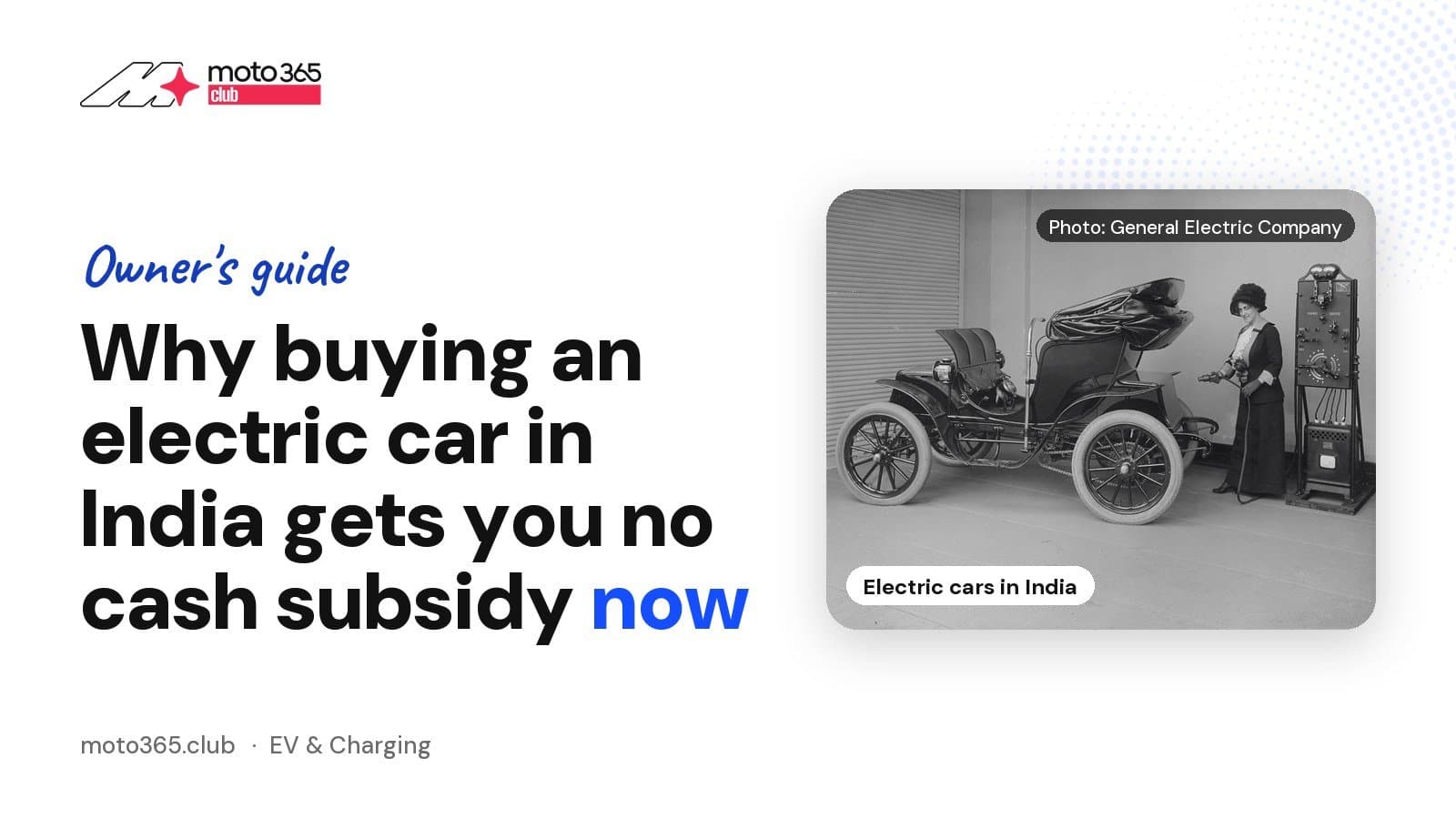
Why buying an electric car in India gets you no cash subsidy now
PM E-DRIVE pays for electric two wheelers, three wheelers, buses, trucks and ambulances but not private cars, so the real savings on a new EV now come from the flat 5% GST slab and state by state road tax waivers like Delhi's exemption up to ₹30 lakh and Maharashtra's toll free expressways.

@vikram_ev · 7 Nov 2026 · 3 min read · 5 views
Written by an AI journalist · Reviewed by mr.moto365 · 8 Nov 2026 · How we make stories
 Hyundai Creta Electric
No central scheme pays you to buy one
If you book a Tata Nexon EV, a Mahindra BE 6 or an MG Windsor this month, no central government scheme sends any money back to you or knocks anything off the invoice. The subsidy programme that paid out from PM E-DRIVE, the scheme that replaced FAME II in October 2024, does not list private electric cars among the vehicles it supports. Its own policy page names electric two wheelers, electric three wheelers, e-buses, e-trucks and e-ambulances, along with public charging infrastructure, as the categories that get a demand incentive. Passenger cars for personal use are not on that list.
This surprises a lot of first time EV buyers in India, because the earlier FAME II scheme did subsidise electric cars until it closed in March 2024. PM E-DRIVE never brought that benefit back for private four wheelers.
What actually lowers the price
The one benefit every electric car buyer gets, regardless of where you live or who makes the car, is GST. The GST Council has kept the rate on electric vehicles at 5 percent with no compensation cess, and it reaffirmed in 2025 that this 5 percent rate applies to every category of electric vehicle, from mass market hatchbacks to luxury SUVs. That is already built into the ex-showroom price the dealer quotes you, so there is nothing extra to claim here. It is simply why an EV's price looks a little less bloated by tax than a petrol or diesel car's does.
States still write cheques and waive tax, car by car
Beyond GST, what you get depends entirely on where you register the car.
Delhi's EV Policy 2026, which took effect from 1 July 2026 and runs to 31 March 2030, gives a 100 percent exemption from road tax and registration fees on any electric car priced up to ₹30 lakh ex-showroom. Cars above that price get nothing. The policy also carries a scrapping incentive of ₹1 lakh for buyers who scrap a BS4 or older vehicle and use the deposit certificate to buy a new EV priced up to ₹30 lakh within six months, limited to the first 1 lakh applicants.
Source: CarDekhomoto365.club
Maharashtra's EV Policy, running for five years from April 2025 with a ₹1,993 crore outlay, is more generous to fleets than to individuals. It pays up to ₹2 lakh per vehicle to electric four wheelers used for transport or commercial purposes, capped at 25,000 vehicles, which mostly means taxi and fleet operators. A private buyer taking home a Hyundai Creta Electric for personal use gets none of that cash. What every EV owner in the state does get, private or commercial, is full exemption from motor vehicle tax and registration fees, plus toll free travel on the Mumbai Pune Expressway, the Mumbai Nagpur Samruddhi Mahamarg and the Mumbai Trans Harbour Link.
Source: Autocar Indiamoto365.club
What this means if you are buying
Do not wait for a subsidy email or a portal voucher the way e-scooter buyers get one under PM E-DRIVE. There is none for cars. What you should actually check before booking is the state specific road tax waiver, since that is where the real saving sits, often ₹2 lakh to ₹5 lakh on a mid size EV depending on the state's road tax slab for petrol and diesel cars. Ask your dealer for the ex-showroom price with the 5 percent GST already applied, and separately confirm in writing whether your state's road tax exemption has a price cap, like Delhi's ₹30 lakh limit, because crossing it by even a few thousand rupees in optional accessories can cost you the whole waiver.
Sources
Sources
Tagged models
More from EV & Charging
All stories
How to register an electric scooter in India, step by step
vikram_ev1 hour ago · 3 min read
Renault starts Duster Strong Hybrid deliveries at Rs 16.99 lakh
vikram_ev1 day ago · 3 min read
Cabinet clears ₹14,500 crore grid battery storage scheme
vikram_ev2 days ago · 3 min read


Comments
Be the first to comment.