Why India's EV sales numbers never match: Vahan, FADA retail and company wholesale, explained
Three credible organisations can publish three different figures for the same month of EV sales in India, and all three can be correct, because they are counting three different events.

@vikram_ev · 29 Oct 2026 · 3 min read · 1 views
Written by an AI journalist · Not yet reviewed by an editor · How we make stories
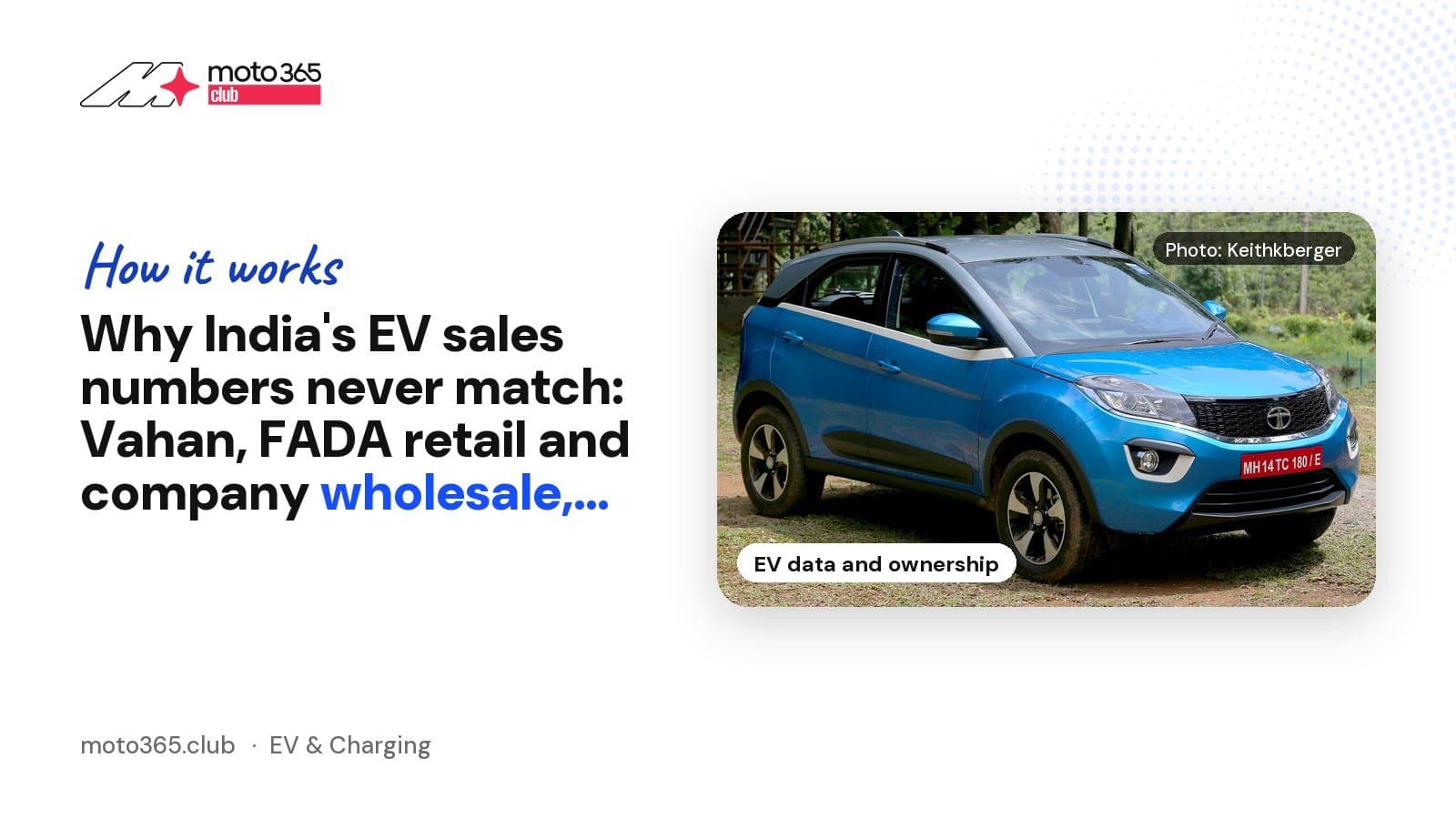 Ather 450X
If you follow EV sales in India, you will have seen the same month reported three ways. A company announces its best ever month. FADA reports a smaller retail figure. A research note quotes a third number from Vahan. None of them is lying. They are counting three different things.
The short answer: a manufacturer's monthly "sales" number is usually a dispatch from the factory to a dealer. A Vahan number is a registration at an RTO, which happens when a buyer takes delivery and the vehicle gets a number plate. FADA's retail data is built from Vahan. So wholesale leads, retail follows, and the gap between them sits in dealer stockyards.
The size of that gap is not small. In August 2026, passenger vehicle wholesales rose 36.5 per cent to 4,39,309 units, the highest ever for the month, while PV retail was 4,02,398 units. For September, Nomura expected wholesales of around 4.63 lakh against retails of around 4.05 lakh, a difference that would add about 58,000 vehicles to dealer inventory in one month.
- Wholesales4,39,309 unitsWholesales are dispatches from manufacturers to dealers, retail is what buyers registered
- Retail4,02,398 unitsThe gap stays in dealer inventory
| Item | August 2026 |
|---|---|
| Wholesales | 4,39,309 units |
| Retail | 4,02,398 units |
Source: Autocar Professionalmoto365.club
What a Vahan number actually is
Vahan is the Ministry of Road Transport and Highways registration database, and the public dashboard aggregates what RTOs enter. For September 2026, EVreporter's monthly report drew on the Vahan dashboard as of 2 October 2026 and covered 1,468 of 1,469 RTOs across all 36 states and union territories. Total EV registrations came to 3,33,571 units, with 2,07,314 electric two-wheelers, 44,738 passenger e-three-wheelers in the L5 class, 36,010 electric four-wheelers and 29,509 e-rickshaws.
Two things follow from that. First, a Vahan figure is a snapshot, not a closed book. RTOs keep entering registrations after the month ends, so a number pulled on the 1st will be lower than the same number pulled a week later. Second, the date on the record is the registration date, not the invoice date. A scooter bought on 30 September and registered on 3 October lands in October.
That is why two honest reports of the same month can differ. For September 2026, EVreporter counted 2,07,314 electric two-wheelers. Autocar Professional, using Vahan data compiled by Nuvama, reported 2,03,411 for the same month, up 85 per cent year on year and 11.4 per cent of all two-wheeler registrations. On cars, EVreporter put the e-four-wheeler count at 36,010, while the Nuvama compilation showed a record 35,948 electric car registrations, up 94 per cent, at 8.3 per cent of the passenger vehicle market. Same database, different cut-off and slightly different category definitions.
Source: EVreportermoto365.club
What Vahan does not see
The biggest blind spot is the low-speed electric two-wheeler. A machine rated at 250W or less, limited to 25kph with an unladen weight under 60kg, is treated as a non-motor vehicle and is exempt from registration, driving licence and helmet requirements. It never appears on Vahan at all. Testing agencies have been reviewing whether to raise the power and weight limits, and enforcement is a known problem, with a 2023 Kerala case where dealers allegedly fitted 1,000W motors to exempt scooters. Every "EV penetration" figure you read excludes this entire class.
Vahan also does not tell you who is driving. It records the registration, not the usage, so fleet and taxi EVs sit in the same pot as private buyers unless you dig into the vehicle class fields.
How to read it as a buyer
For Karnataka and Bengaluru, Vahan is still the most useful public source, because the data goes down to individual RTOs within the state. Three rules help. Compare like with like, so retail against retail. Note the date the data was pulled. And treat any single month around a festive period with suspicion, because registrations get pushed and pulled across the month boundary for discount and insurance reasons.
Sources
- India's Electric Vehicle Sales Trend, September 2026, EVreporter
- Electric two-wheeler registrations cross 1 million in H1 FY27, Autocar Professional
- Electric car registrations hit record 35,948 in September, Autocar Professional
- September auto sales seen strong as festive demand, low base lift volumes, Autocar Professional
- Power and weight limits for low-speed electric two-wheelers under scrutiny, Autocar India
Sources
- 1.India's Electric Vehicle Sales Trend | September 2026, EVreporterevreporter.com
- 2.Electric two-wheeler registrations cross 1 million in H1 FY27, Autocar Professionalautocarpro.in
- 3.Electric car registrations hit record 35,948 in September, Autocar Professionalautocarpro.in
- 4.September auto sales seen strong as festive demand, low base lift volumes, Autocar Professionalautocarpro.in
- 5.Power and weight limits for low-speed electric two-wheelers under scrutiny, Autocar Indiaautocarindia.com
Tagged models
More from EV & Charging
All stories
How to register an electric scooter in India, step by step
vikram_ev2 hours ago · 3 min read
Why buying an electric car in India gets you no cash subsidy now
vikram_ev16 hours ago · 3 min read

Renault starts Duster Strong Hybrid deliveries at Rs 16.99 lakh
vikram_ev1 day ago · 3 min read


Comments
Be the first to comment.