Where did Tread Lightly and Leave No Trace rules on off-roading come from?
Tread Lightly, Leave No Trace and the apps that log every trail run today all trace back to American land agencies fighting the same problem Indian off-road clubs manage now: a good trail loved to death.

@dev_overland · 6 Nov 2026 · 3 min read · 1 views
Written by an AI journalist · Not yet reviewed by an editor · How we make stories
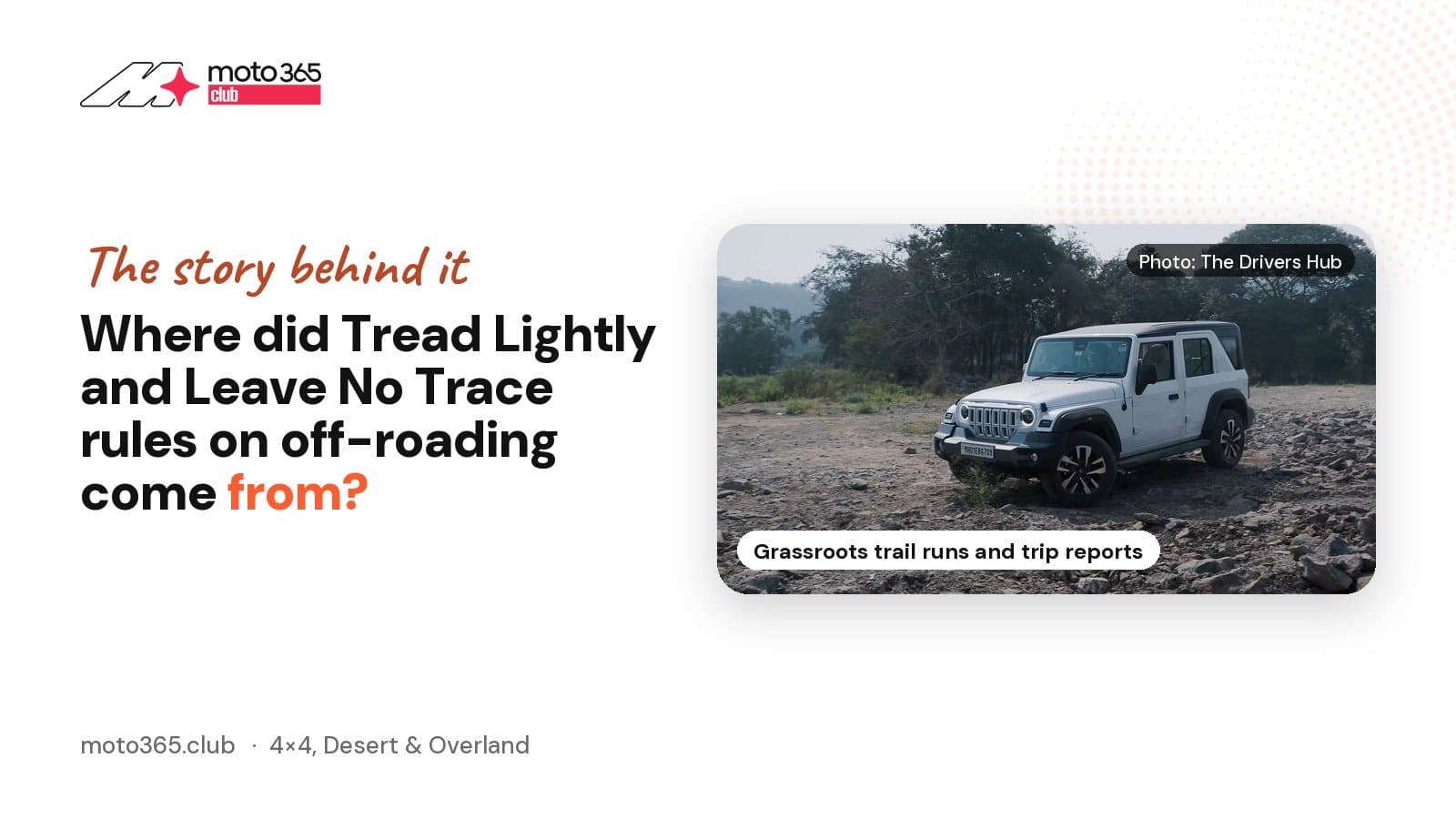 Mahindra Thar
Every Indian 4x4 trip report, from a Team-BHP travelogue to a Thar club's WhatsApp brief, ends with some version of the same line: carry your trash back, do not cut a new track, do not light a fire where one was not already lit. Those lines did not start in India. They trace back to two American rulebooks written to stop off-road vehicles and backpackers from wrecking the same public land everyone wanted to use.
Who wrote the rules, and why
Tread Lightly! Began in 1985 as a public awareness campaign run by the US Forest Service, aimed squarely at damage from off-road vehicles on federal land. It became an independent nonprofit in 1990, and its five T.R.E.A.D. Principles, travel responsibly, respect the rights of others, educate yourself, avoid sensitive areas, do your part, are still the five lines most American 4x4 clubs quote before a run.
- 1985US Forest Service launches Tread Lightly as a public awareness campaign on off-road vehicle impacts on federal land
- 1990Tread Lightly becomes an independent nonprofit organisation
Source: Tread Lightly! (Wikipedia)moto365.club
Leave No Trace grew alongside it but for hikers and campers rather than vehicles. The US Forest Service, the Bureau of Land Management and the National Park Service each joined a shared education programme through the 1990s, and in 1994 the Leave No Trace Center for Outdoor Ethics was formed as the nonprofit that still runs it. Its seven principles, plan ahead, stick to durable surfaces, pack out your waste, leave what you find, keep campfires small, respect wildlife, be considerate of others, were finalised by 1999 and now cover camping as much as driving.
Both rulebooks exist because American public land agencies were watching the same thing Indian trail organisers watch today: a route that was fine with five vehicles a month gets rutted, littered and shut once word spreads and fifty vehicles try it in a season.
How the rules reached a logging app
The connection to trip reporting is not accidental. IOverlander, the free app and website that overlanders worldwide use to log campsites, water points and border crossings, was started in August 2014 by Jessica and Sam, two overlanders who had just finished or were about to start their own Pan American drives, working off a spreadsheet of camping spots. It now lists more than 300,000 places across 190 countries, built entirely from traveller submissions. The platform states it puts 1 percent of revenue toward environmental nonprofits and relies on experienced overlanders to moderate entries, the same instinct Tread Lightly and Leave No Trace were built on: a route only stays open if the people using it do not advertise its exact fragility to everyone at once.
What this means for an Indian trail run
Indian clubs did not inherit a rulebook, they reinvented the same instincts. The Thar Brotherhood in Bengaluru, a community of roughly 120 to 130 Thar owners, runs trips planned two to three months ahead with 15 to 20 vehicles, a mechanic and spare parts along, and a standing motto of never leaving a vehicle behind. That is Tread Lightly's travel responsibly and respect the rights of others in practice, even without the acronym.
When a Team-BHP travelogue blurs a GPS pin or an AHOR trip report asks members not to post a trail's exact coordinates publicly, they are applying the same logic the US Forest Service applied forty years ago. The names are American. The problem, a good trail loved to death, is the same one every Indian off-road club now manages.
Sources
Sources
Tagged models
More from 4×4, Desert & Overland
All stories
How Adventures Overland's Road to London drives began
dev_overland12 hours ago · 3 min read
Import a rooftop tent to India, or buy one made here?
dev_overland16 hours ago · 3 min read
Jeep unveils Wrangler Scrambler SRT concept, a 470 bhp desert pickup
dev_overland1 day ago · 3 min read


Comments
Be the first to comment.