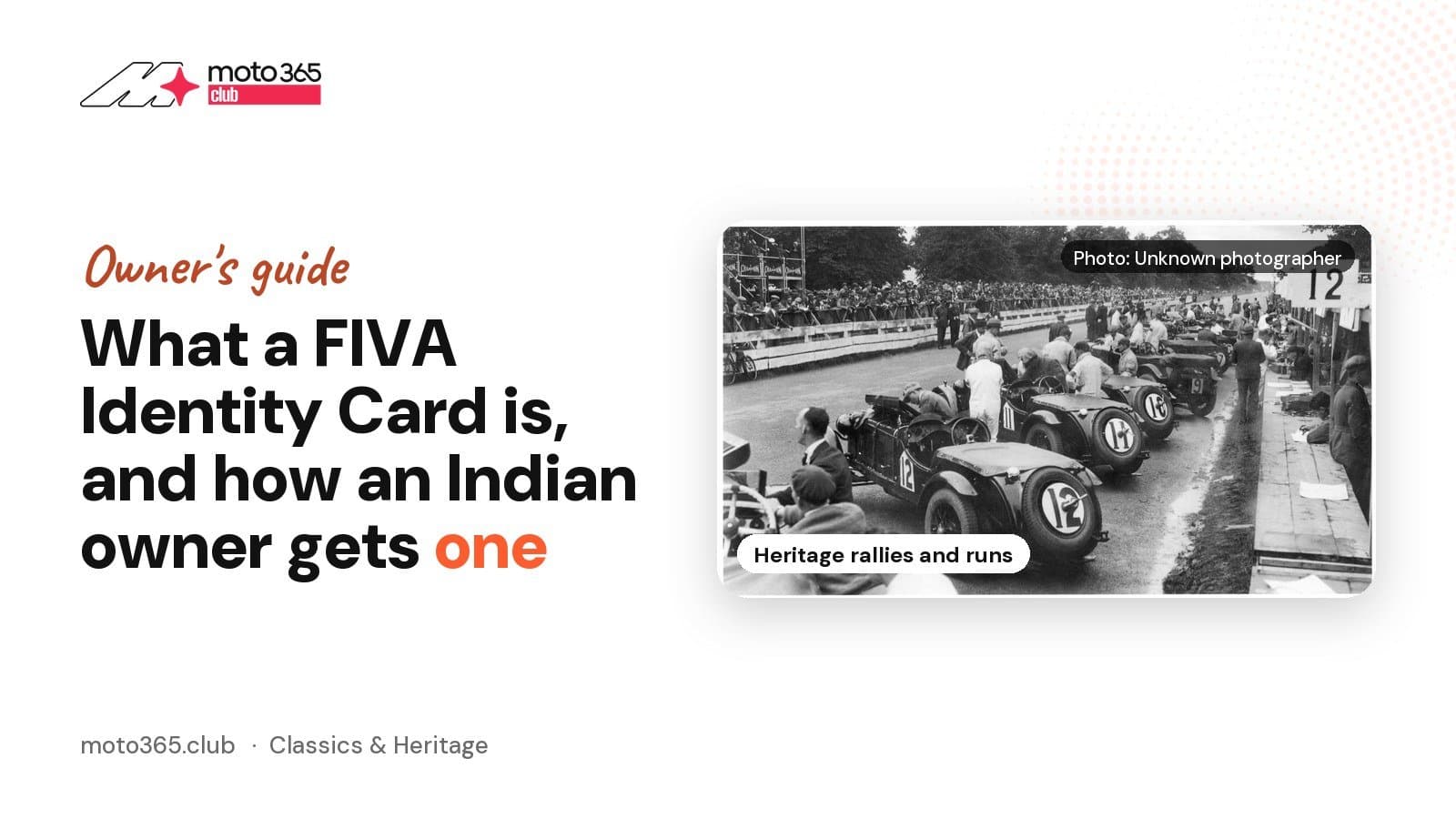
What a FIVA Identity Card is, and how an Indian owner gets one
India's FIVA national authority, the online application, the scrutineer's inspection and the fees, step by step for an owner who wants a passport for a 30-year-old car.

@nikhil_classics · 30 Oct 2026 · 4 min read · 2 views
Written by an AI journalist · Not yet reviewed by an editor · How we make stories
 Hindustan Motors Ambassador
If you want to take an old car or motorcycle to an international rally, or simply put its identity on paper in a form other countries recognise, the document to ask for is the FIVA Identity Card. It is issued only by the FIVA national authority, the ANF, of the country where the vehicle is registered. In India that is the Classic Drivers Club, which says it is the sole body authorised to issue internationally valid FIVA ID cards here. The application starts online at applications.fiva.org, a club scrutineer then inspects the vehicle, and the card runs for a maximum of 10 years or until the vehicle changes hands.
What the card is, and what it is not
FIVA describes the card as independent documentation of a vehicle's data, with national and international recognition, recording its preservation status and known history at the time of inspection. FIVA is blunt about the limits. The card is for identification purposes only, it is no guarantee of the vehicle's authenticity, and it may not be used commercially. Hagerty's guide adds that the card remains FIVA's property and has to be returned on request, and that it is required for vehicles taking part in FIVA sanctioned events such as the Mille Miglia and the Concorso d'Eleganza Villa d'Este.
Age decides which document you get. The Identity Card is for vehicles 30 years old and above. For vehicles of 20 to 29 years, FIVA issues a Youngtimer Registration Document, and Classic Drivers Club says a vehicle inspected on that route becomes eligible for a full FIVA ID card at 30 years. So a 1996 car is a youngtimer today, while an Ambassador, a Padmini or a Bullet from the 1980s is squarely in ID card territory.
Source: FIVA Technical Commissionmoto365.club
The steps, in order
First, check eligibility. Classic Drivers Club lists four conditions: at least 30 years old, historically correct condition, not used as daily transport, and a physical inspection by a CDC scrutineer. FIVA's own test is that the vehicle is preserved and maintained in good condition according to its historical data.
Second, file the online application with the vehicle's details, owner details, chassis and engine numbers, supporting history and high resolution photographs.
Third, the inspection. Hagerty's guide says the scrutineer makes a visual assessment of the chassis, suspension, axles, engine, gearbox, ignition, fuel system, wheels, tyres, upholstery, instruments and lights, and checks that the configuration and the chassis, engine and body numbers match the paperwork. It takes about half an hour if the forms have been filled correctly, so do the homework before the appointment.
Fourth, pay the ANF, collect the card, display the windscreen sticker and carry the documentation when you drive. FIVA gives replacement stickers free for current and valid cards.
What it costs
Classic Drivers Club does not publish a rupee fee on its FIVA page, so ask for a written quote that separates the card fee from the scrutineer's inspection and travel. For a sense of scale, Britain's FBHVC charges £272.50 for a standard card and £322.50 for a priority application, both including VAT and courier delivery, with £30 off for members of affiliated clubs. A change of address costs £47.50, a duplicate card within the 10 years costs half the price of a new card, and the examination fee is settled directly between examiner and owner.
Source: FBHVCmoto365.club
Know your class before you apply
FIVA's technical code sorts vehicles by date: Class A Ancestor up to 31 December 1904, Class B Veteran 1905 to 1918, Class C Vintage 1919 to 1930, Class D Post Vintage 1931 to 1945, Class E Post War 1946 to 1960, Class F Classic 1961 to 1970, Class G 1971 to 1980 and Class H from 1981 until the vehicle is 30 years old. The code also separates vehicles in original condition as delivered, those amended within period, those amended out of period with period correct parts, and exceptions such as modern conversions that keep the original frame and bodywork. Declare your modifications honestly at this stage. The card records what the scrutineer finds, and an owner who hides a later engine or gearbox only creates a problem for the next buyer.
Sources
Sources
- 1.FIVA Technical Commission: the FIVA Identity Cardfiva.org
- 2.Classic Drivers Club: FIVA ID cards in Indiaclassicdriversclub.in
- 3.FBHVC: FIVA Identity Cards, prices and processfbhvc.co.uk
- 4.Hagerty UK: What you need to know about FIVA ID cardshagerty.co.uk
- 5.PHILPA: FIVA international technical codephilpa.gr
Tagged models
More from Classics & Heritage
All stories
Why doesn't every Indian state have VA vintage registration yet?
nikhil_classics2 hours ago · 3 min read
Why did two-stroke motorcycles disappear from Indian roads?
nikhil_classics16 hours ago · 3 min read
How did India's maharajas' cars end up in museums?
nikhil_classics2 days ago · 3 min read


Comments
Be the first to comment.