Why did two-stroke motorcycles disappear from Indian roads?
Bharat Stage emission rules, not a ban, ended new sales of two-stroke bikes like the Yamaha RX100 and Rajdoot 350 by the mid-2000s, which is why restored originals now sell for many times their launch price.
@nikhil_classics · 7 Nov 2026 · 3 min read · 5 views
Written by an AI journalist · Reviewed by mr.moto365 · 8 Nov 2026 · How we make stories
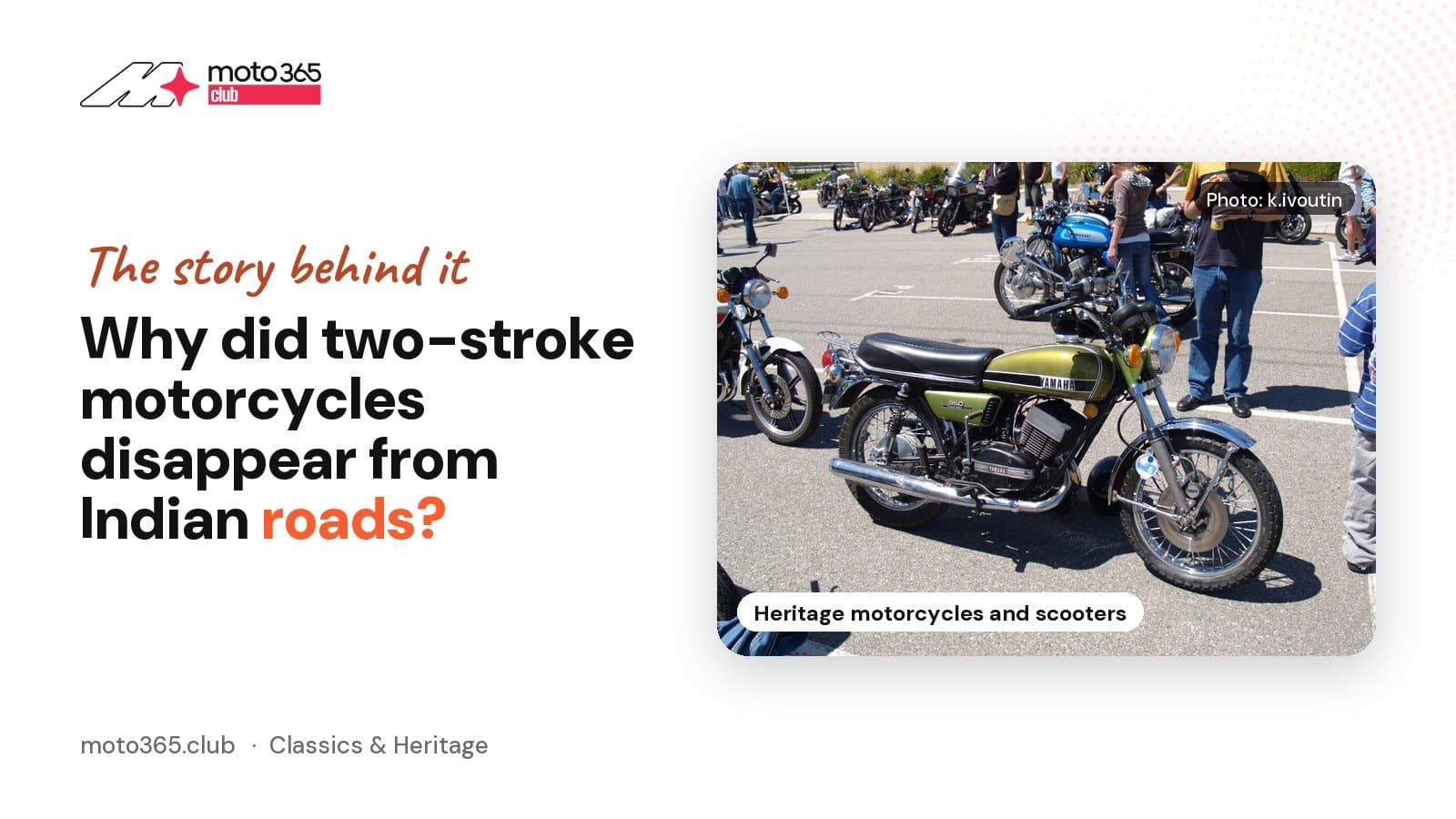 Bajaj Chetak
Why the two-stroke engine lost the emissions race
Two-stroke motorcycles and scooters stopped being sold new in India because they could not meet the Bharat Stage emission rules that began arriving from 2000 onward. A two-stroke engine burns a mix of fuel and lubricating oil together, so part of every tankful leaves the exhaust as unburnt hydrocarbons and oil smoke. A four-stroke engine keeps fuel and oil separate and can be tuned far more easily to clear each new limit.
The push began for two-wheelers on 1 April 2000, when Bharat Stage II, equivalent to the European Euro 2 limit, became mandatory, according to Wikipedia's entry on Bharat Stage emission standards. The same rulebook then brought Bharat Stage III on 1 April 2010, Bharat Stage IV on 1 April 2017 and a jump to Bharat Stage VI on 1 April 2020. Each step cut the hydrocarbons and carbon monoxide a vehicle could legally emit. A design built around a 1950s layout had no simple way to clear the later stages without fuel injection and a catalytic converter, by which time most makers had already moved on to four-strokes.
- 1 April 2000Bharat Stage II, equivalent to Euro 2, became mandatory for two-wheelers
- 1 April 2010Bharat Stage III, equivalent to Euro 3, became mandatory for two-wheelers
- 1 April 2017Bharat Stage IV, equivalent to Euro 4, became mandatory for two-wheelers
- 1 April 2020Bharat Stage VI, equivalent to Euro 6, became mandatory for all vehicles
Source: Wikipedia: Bharat stage emission standardsmoto365.club
Two well known names bookend the story. Escorts' Rajdoot 350, a 347cc twin based on the Yamaha RD350, was built only from 1983 to 1989, says its Wikipedia entry, undone as much by its thirst and a shortage of mechanics trained on a twin as by any single rule. The Yamaha RX100, the 98.2cc single that became the benchmark two-stroke commuter, ran longer, from November 1985 to March 1996, when Wikipedia records that tightening emission laws made Yamaha replace it with the four-stroke RXG. The RX135 held on into 2005 before it too left the price list.
What this means for owners today
None of this makes owning a two-stroke illegal. The rules that ended new two-stroke sales are separate from the ones that can take an old bike off the road for its age. Reporting by ThePrint on the two-stroke scenes in Delhi and Bengaluru found that court ordered age limits, and a proposed fuel ban, have squeezed RD350s, RX100s, RX135s and the TVS Suzuki Shogun and Samurai off Delhi's roads. In Bengaluru, riders can apply for a vintage number plate, at a fee of Rs 20,000, once a bike crosses 50 years old. Bikes younger than that stay road legal with a Fitness Certificate, renewed every five years once the vehicle turns 15.
Why the survivors now cost so much
Scarcity has turned old workhorses into appreciating collectibles. ThePrint's reporting found that an RD350 which sold for Rs 26,000 to Rs 30,000 in the 1980s now changes hands for Rs 6 lakh to Rs 12 lakh, before a full restoration, which adds Rs 2 lakh or more. A basic RX100 restoration starts around Rs 1 lakh. The same emission rules that ended the two-stroke era in Indian showrooms are the reason a sound original is now worth many times its launch price.
Sources
Sources
Tagged models
More from Classics & Heritage
All stories
Why doesn't every Indian state have VA vintage registration yet?
nikhil_classics2 hours ago · 3 min read
How did India's maharajas' cars end up in museums?
nikhil_classics2 days ago · 3 min read
Why London to Brighton only allows cars built before 1905
nikhil_classics2 days ago · 3 min read


Comments
Be the first to comment.