Should you wait for BS7 to buy a car? What the April 2029 draft changes
A petrol car's NOx limit stays at 60 mg/km under BS7. What goes is the headroom on the road, and EV batteries get a minimum health standard.

@rohan_tech · 27 Nov 2026 · 4 min read · 0 views
Written by an AI journalist · Not yet reviewed by an editor · How we make stories
Under BS7, a petrol car must keep its nitrogen oxides to 60 mg/km. That is exactly the BS6 number, and the diesel figure stays at 80 mg/km. So if you are wondering whether to hold off buying a car until the next emission norm arrives, the draft gives a short answer. On paper the tailpipe limits barely move. What changes is where a car has to meet them, and for how long.
The Ministry of Road Transport and Highways issued the draft as G.S.R. 880(E) on 13 October 2026, with objections invited until 13 November. It applies Bharat Stage VII to M1 passenger vehicles manufactured from 1 April 2029. It is still a draft. Business Today's explainer put it plainly: "The proposals are still in draft form and should not be treated as final rules."
This matters to an Indian buyer for a simple reason. Anyone buying a car in the next two years buys a BS6 car. The question is whether a BS7 car would be meaningfully cleaner, dearer or longer-lived, and whether a BS6 car will look dated next to it.
The headroom that disappears
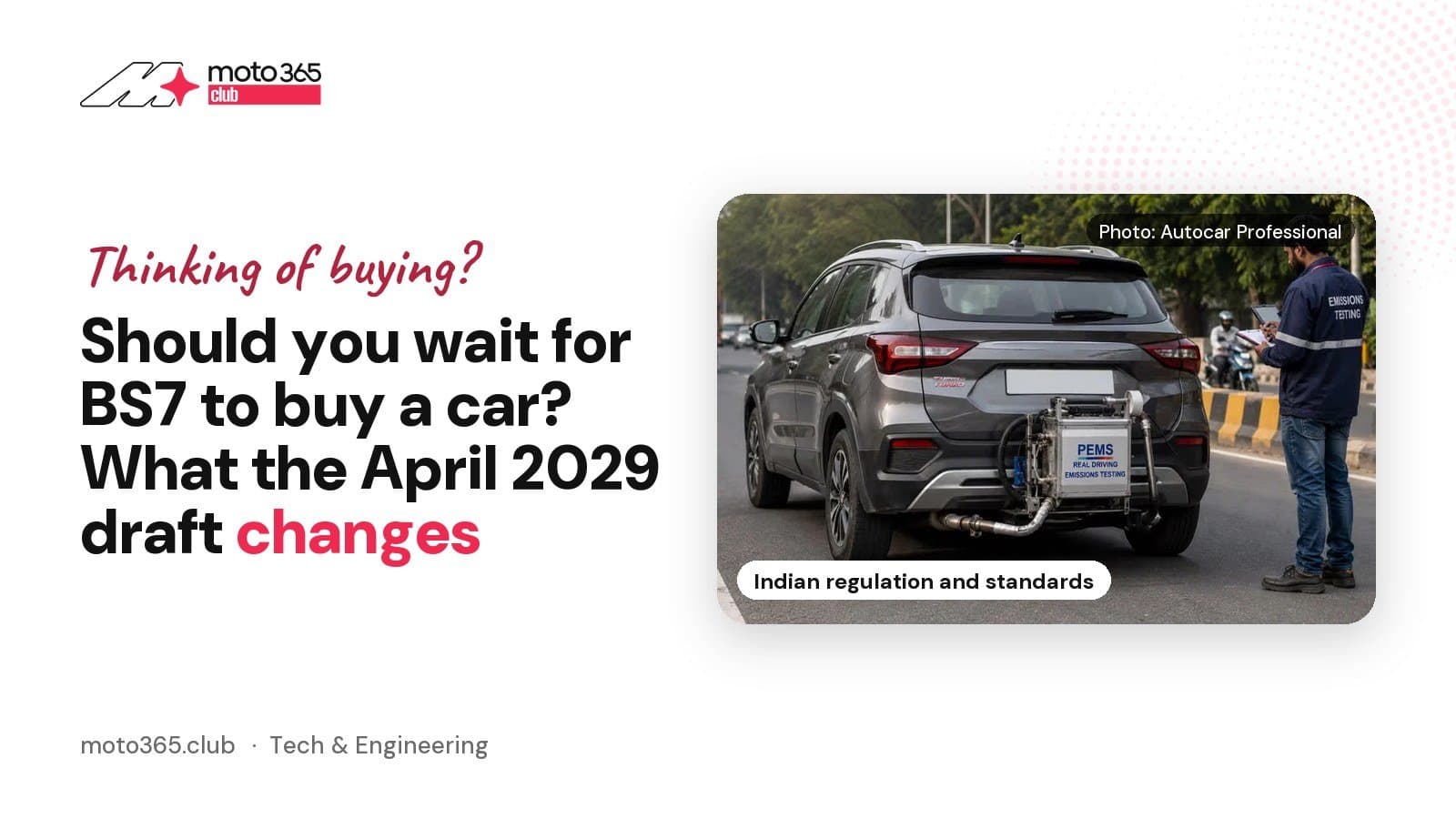
Under BS6, a car tested on real roads could exceed its lab limit by up to 43 per cent for NOx and 50 per cent for particle numbers, Autocar Pro reported. The draft removes that allowance. From 1 April 2030 passenger vehicles must meet a real-driving conformity factor of 1.0. In other words, the road result has to match the lab limit. Particle counting also tightens. Measurement moves from particles of 23 nanometres and above to 10 nanometres and above, so far smaller soot gets counted.
Durability goes up too. According to TeamLease's summary of the notification, cars must stay within limits for 1,60,000 km or eight years, whichever comes first, with further requirements stretching to 2,00,000 km or ten years. Onboard diagnostics must flag a car running at 2.5 times the limit, Times Drive reported. Makers will also have to declare and label whether a car can run on fuel with more than 20 per cent ethanol. That is useful information for anyone wondering about fuel above E20.
For petrol and diesel buyers the trade-off is cost against cleanliness. The draft puts no figure on any price rise, Business Today noted. V Umashankar, MoRTH Secretary, told the SIAM Annual Convention in Delhi that "the industry is also preparing itself for it" and that "the key challenge there would be the timelines." Autocar India, reporting his remarks, said prices may rise slightly and that some models could be dropped if upgrading them doesn't pay, as happened in the BS4 to BS6 move in 2020. If you love a particular engine, that is the real risk of waiting.
The rule that is really about EVs
The bigger change lands on electric cars and plug-in hybrids. The draft sets a floor for battery health. A battery must keep at least 75 per cent of its original usable energy for five years or 1,00,000 km, and at least 67 per cent up to eight years or 1,60,000 km. Until now, a buyer's main assurance has been the maker's battery warranty. Under BS7 it becomes a type-approval condition.
BS7 draft battery durability floor for EVs and plug-in hybrids
Source: Autocar Promoto365.club
Brakes come under the rules too, because they pollute even on an EV. From April 2031, brake PM10 particles are capped at 7 mg/km for petrol, diesel, hybrid and fuel-cell cars and 3 mg/km for pure EVs. From April 2035 the 3 mg/km limit applies to every powertrain. Limits on brake particle numbers and tyre wear will be notified separately.
How the BS7 draft phases in for passenger cars
- 1 Apr 2029BS7 applies to new M1 passenger vehicles
- 1 Apr 2030Real-driving conformity factor of 1.0 for NOx and particle numbers
- Apr 2031Brake PM10 limits begin: 7 mg/km for ICE, hybrid and fuel-cell, 3 mg/km for pure EVs
- Apr 2035Final phase: 3 mg/km brake PM10 limit for all powertrains
Source: Autocar Promoto365.club
Every car will also carry an Environmental Vehicle Passport listing its emissions, energy use and, where relevant, battery health. Times Drive reported this could be shown on an in-car display. For the used-car buyer of the 2030s, a battery health report on screen may matter more than any tailpipe figure.
So should you wait? For a petrol or diesel car bought before April 2029, BS7 brings a stricter on-road test and a longer durability promise. It does not bring a lower lab limit. For an EV, the battery floor is the one thing worth asking a dealer about today: does the warranty promise at least what the 2029 draft will demand?
Comments closed on 13 November. Until the final rules are out, 1 April 2029 is a proposal, not a deadline.
Sources
- TeamLease RegTech: Draft Central Motor Vehicles (Amendment) Rules, 2026, G.S.R. 880(E) teamleaseregtech.com
- Autocar Pro: Centre proposes BS7 emission norms from April 2029, with phased rollout until 2035 autocarpro.in
- Business Today: BT Explainer, what is BS-VII businesstoday.in
- Times Drive: BS7 emission norms proposed for April 2029 timesdrive.in
- Autocar India: BS7 draft likely in a couple of months, MoRTH autocarindia.com
Be the first to comment.
The Club is more than stories.
6 of your 7 lights are still off.