How to install a car OTA update in India, and what to do if it fails
Mahindra's Gemini download reaches the original BE 6 on 1 January 2027, and the usual cause when an install stalls is the small battery, not the big one.

@rohan_tech · 27 Nov 2026 · 4 min read · 0 views
Written by an AI journalist · Not yet reviewed by an editor · How we make stories
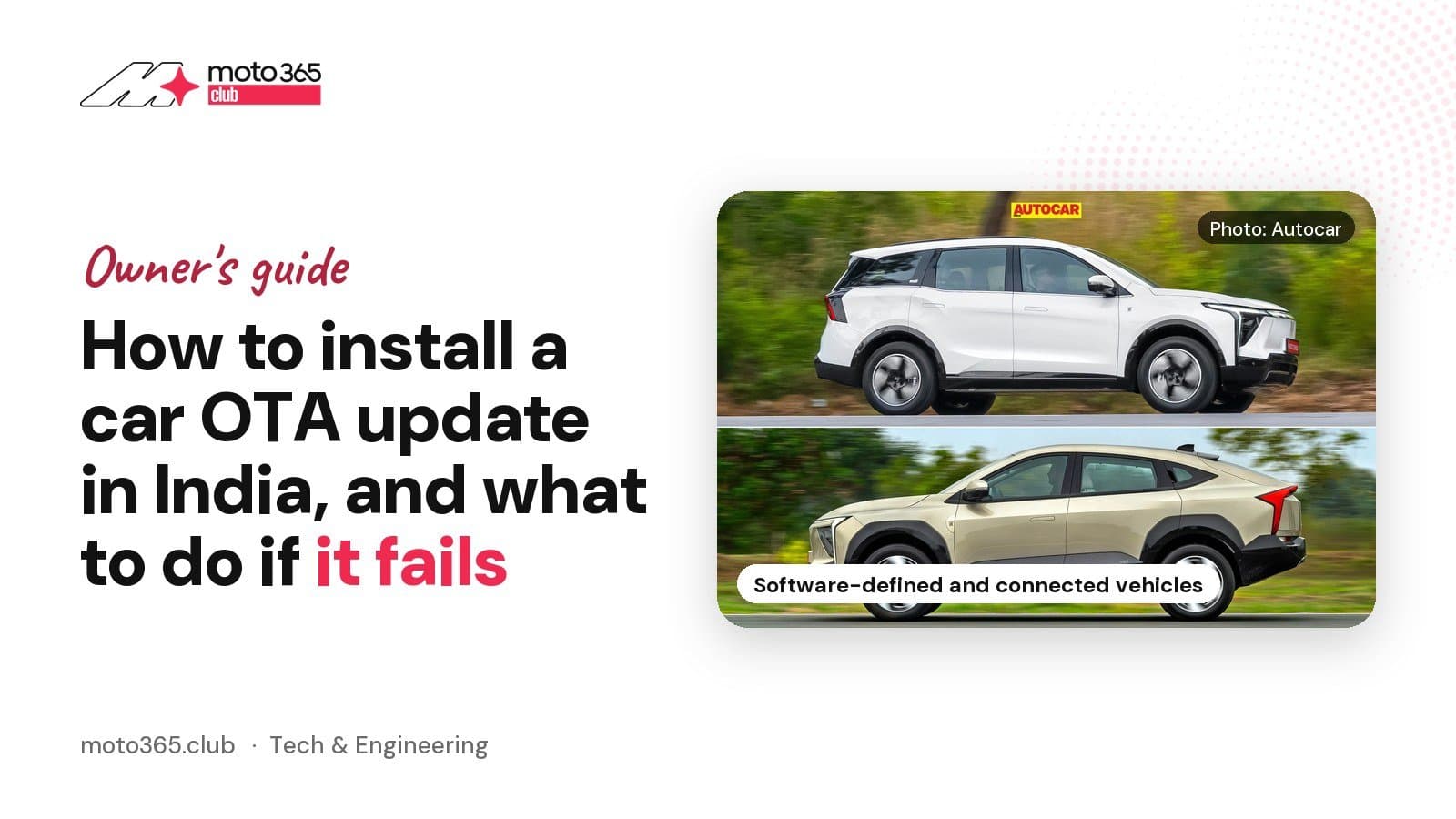
"From 1st January 2027, Google Gemini will go live on all other cars, including the original BE 6," R Velusamy, President, Automotive Business at Mahindra & Mahindra, told Autocar India in August. The cars he means are the XEV 9e, the XEV 9S and the first BE 6. None of them goes back to a workshop for it. The new assistant arrives over the air, as a software download.
That makes an ordinary owner the person running a software install on a car that costs more than ₹20 lakh. Autocar India lists the XEV 9e from ₹21.90 lakh and the XEV 9S from ₹21.40 lakh. Mahindra says Gemini will power its in-car assistant with 17 specialised AI agents and 48 applications. It says more feature packs, from digital keys to custom drive modes, will follow in phases from January 2027.
This matters in India because over-the-air (OTA) updates have moved from luxury cars to mass-market ones. Hyundai's new Venue is the first Hyundai in India to launch with OTA, according to Hyundai Motor India's Bluelink page. Tata's new Sierra uses an OTA and remote diagnostics platform from Excelfore, Autocarpro reported in April. Most owners will see an update prompt sooner or later. If you know what to do with it, you save a trip to the dealer.
One menu, one button, no going back
On a Mahindra electric SUV, the steps are in a June 2026 guide on Mahindra's own eSUV site. Open the main menu on the infotainment screen. Select Vehicle Apps, then Updates. Read the update details, tap Update, and wait for it to download and install. A confirmation appears at the end. Mahindra says some updates need the car to stay stationary and that the time taken depends on the size of the update. It adds that certain updates may need a service centre visit afterwards. Most settings stay as they were. If nothing shows under Updates, the car is already current.
Hyundai's process starts with Bluelink. It must be activated, and the car needs 4G coverage. The update downloads by itself, even while you drive, and a prompt arrives on the screen or in the Bluelink app. Nothing installs without your approval. With the engine off, an update window appears with an "Update Now" button, and the screen shows how long the install will take. You can choose "later" before it starts, but once it has begun it cannot be cancelled. During the install you cannot drive the car, charge an EV or use remote start. When it finishes, the screen shows a confirmation with a QR code. Hyundai says older models, with or without Bluelink, cannot be retrofitted for OTA. Neither Mahindra nor Hyundai lists a charge for these updates.
When the progress bar stops
A failed install is rarely about the big traction battery. The ev.care service team wrote in a June guide for Indian EV owners that "the most common cause of a failed OTA install is a weak 12-volt battery." Updates typically need the 12V battery above about 80 to 95 per cent, it says. Its other suspects are a patchy mobile signal, someone opening a door or pressing start mid-install, and a fault on the carmaker's servers during the rollout.
Its advice, in order. Try a soft reset of the head unit with a long press of the power or volume knob for 10 to 20 seconds. If that fails, switch the car off, lock it and wait 15 to 30 minutes. Top up the 12V battery by plugging into AC charging or driving for 30 to 60 minutes, and unplug dashcams and OBD dongles first. Then retry the update parked in the open with a good signal, not in a basement, and leave the car alone until it finishes. If it still fails, the dealer can re-flash the module, which ev.care says is free under warranty. If the cluster shows brake, drivetrain or "stop safely" warnings, stop resetting and call roadside assistance. Hyundai says its system will tell you whether the car is safe to drive and whether to call customer care, a dealer or roadside assistance. Mahindra's helpline is 1800 209 6006.
The real bills arrive only when hardware has failed. Ev.care puts a head unit board repair at ₹4,000 to ₹18,000 and a full head unit replacement at ₹25,000 to ₹90,000 or more. It says these figures are indicative and vary by model.
Newer platforms are built to recover on their own. The Excelfore system on the Sierra supports rollback and recovery, and it can manage several ECUs together, Autocarpro reported. Once a Hyundai install begins, it cannot be cancelled. On 1 January, Mahindra owners will find out how theirs behaves.
Sources
- All Mahindra born EVs to get Google Gemini by January 2027 (Autocar India) autocarindia.com
- How to update software in Mahindra eSUVs (Mahindra) mahindraelectricsuv.com
- Bluelink OTA (Hyundai Motor India) hyundai.com
- EV OTA Update Failed or Stuck: What to Do (India) (ev.care) ev.care
- Excelfore Powers Tata Sierra with OTA Update and Remote Diagnostics Platform (Autocarpro) autocarpro.in
Also in this story
Be the first to comment.
The Venue is more than a story here.
6 of your 7 lights are still off.