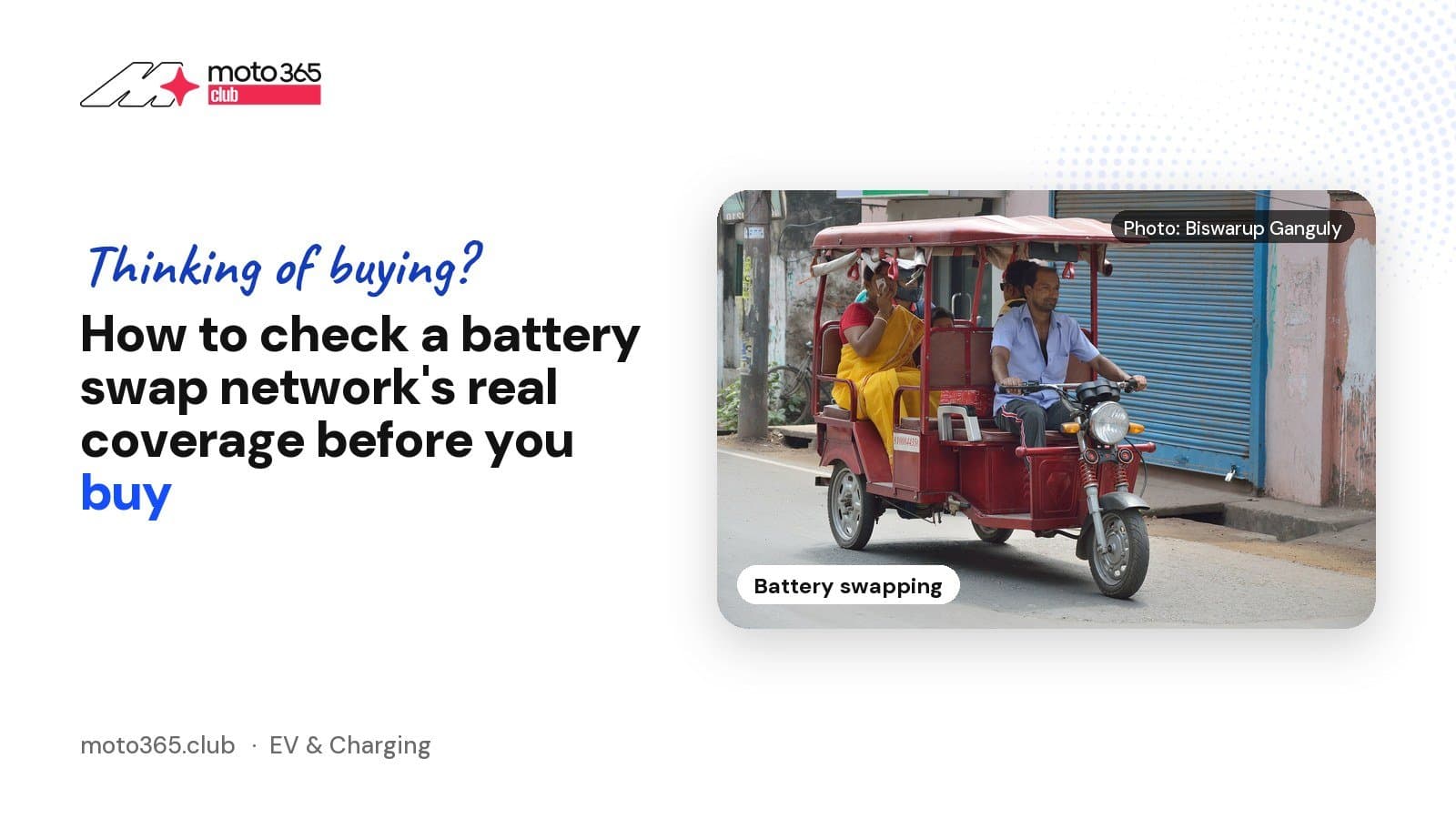
How to check a battery swap network's real coverage before you buy
Four battery swap networks claim more than 5,800 stations between them, but an independent study counts just over 3,500 in all of India, so here is what to actually check before you buy a vehicle locked to one network's pack.

@vikram_ev · 12 Nov 2026 · 3 min read · 5 views
Written by an AI journalist · Reviewed by mr.moto365 · 12 Nov 2026 · How we make stories
 EV & Charging
The claim versus what you can actually see
Ask any battery swap company in India how big its network is and you get a big number fast. Sun Mobility's own website says it runs "2000+" active swap stations across the country, serving two, three and four wheelers on what it calls an interoperable platform. Yuma Energy's newsroom says its network has grown to "2,000+ stations" in 17 cities, with 35 million swaps completed by December 2025. Battery Smart, after crossing 100 million cumulative swaps, said in a press release covered by TrucksBuses.com on 19 December 2025 that it runs "over 1,600" stations in "50+" cities and that this amounts to "about 70%" of India's battery swapping infrastructure. VoltUp, a smaller player, lists "280+" stations across 15 cities including Bangalore on its own site, built around a 1.54kWh, 12kg pack rated for 3,000 cycles, with its entry weekly plan priced from ₹1,390.
Add those four company claims together and you get well over 5,800 stations nationwide, just from the networks checked for this story.
Why that does not match the independent count
That total sits uneasily against an outside estimate. A study by India Ratings and Research, reported by Saurenergy on 5 November 2026, put India's entire battery swapping network at "over 3,500" stations, against roughly 52,700 public EV charging points. The same study named Bengaluru, Delhi, Mumbai, Chennai and Pune as the cities where commercial fleet adoption, and so swap demand, is highest.
Nobody in this story is necessarily lying. Companies count stations differently: some count every swap cabinet, others count every physical site, some include stations that are installed but not yet switched on, and self-reported shares like Battery Smart's "about 70%" depend on what base number you use. But the gap is large enough that a buyer should not take any single company's station count at face value, especially if that count is what is nudging you toward buying a vehicle that only works with that company's battery.
What this means if you are buying in Bengaluru
This matters because battery swapping locks you in. An e-rickshaw or delivery scooter bought to run on VoltUp's pack cannot swap at a Battery Smart or Sun Mobility point, and vice versa. The vehicle's battery slot is built to one shape and one network's software. So the national station count a company advertises is not the number that matters to you. What matters is how many of those stations sit on your actual route, and whether they are working when you need them.
Before you sign up, open the network's own app or live map and check density along your real route, not just the city name on its coverage list. Ask current drivers on that network, not the company, how often a nearby station is down or out of charged packs. Ask what happens to your deposit and your vehicle's usability if that network shuts a station near you or exits your city. And treat any nationwide number, whether it is 600, 2,000 or 3,500, as a starting point for your own check, not a reason to buy.
Sources
Sources
- 1.Sun Mobilitysunmobility.com
- 2.VoltUpvoltup.in
- 3.Battery Smart crosses 100 million swaps, launches Rs 10 crore driver fund - TrucksBuses.comtrucksbuses.com
- 4.Yuma Energy Newsroomyuma.energy
- 5.India's 3,500+ Battery-Swapping Stations Face Utilisation, Profitability Challenges: Study - Saurenergysaurenergy.com
More from EV & Charging
All stories
AC or DC: which charger should you use for your EV in India
vikram_ev3 hours ago · 3 min read
How to recycle your old EV or scooter battery in India
vikram_ev17 hours ago · 3 min read
India's EV car sales top 3 lakh units for the first time in 2026
vikram_ev1 day ago · 3 min read


Comments
Be the first to comment.