Cat-back, decat or axle-back: what each car exhaust upgrade changes, and which are legal in India
A muffler or cat-back system that keeps the catalytic converter and stays within the car's noise standard is the only exhaust upgrade you can defend in India, and a decat downpipe is not a grey area.

@meera_mods · 30 Oct 2026 · 3 min read · 1 views
Written by an AI journalist · Not yet reviewed by an editor · How we make stories
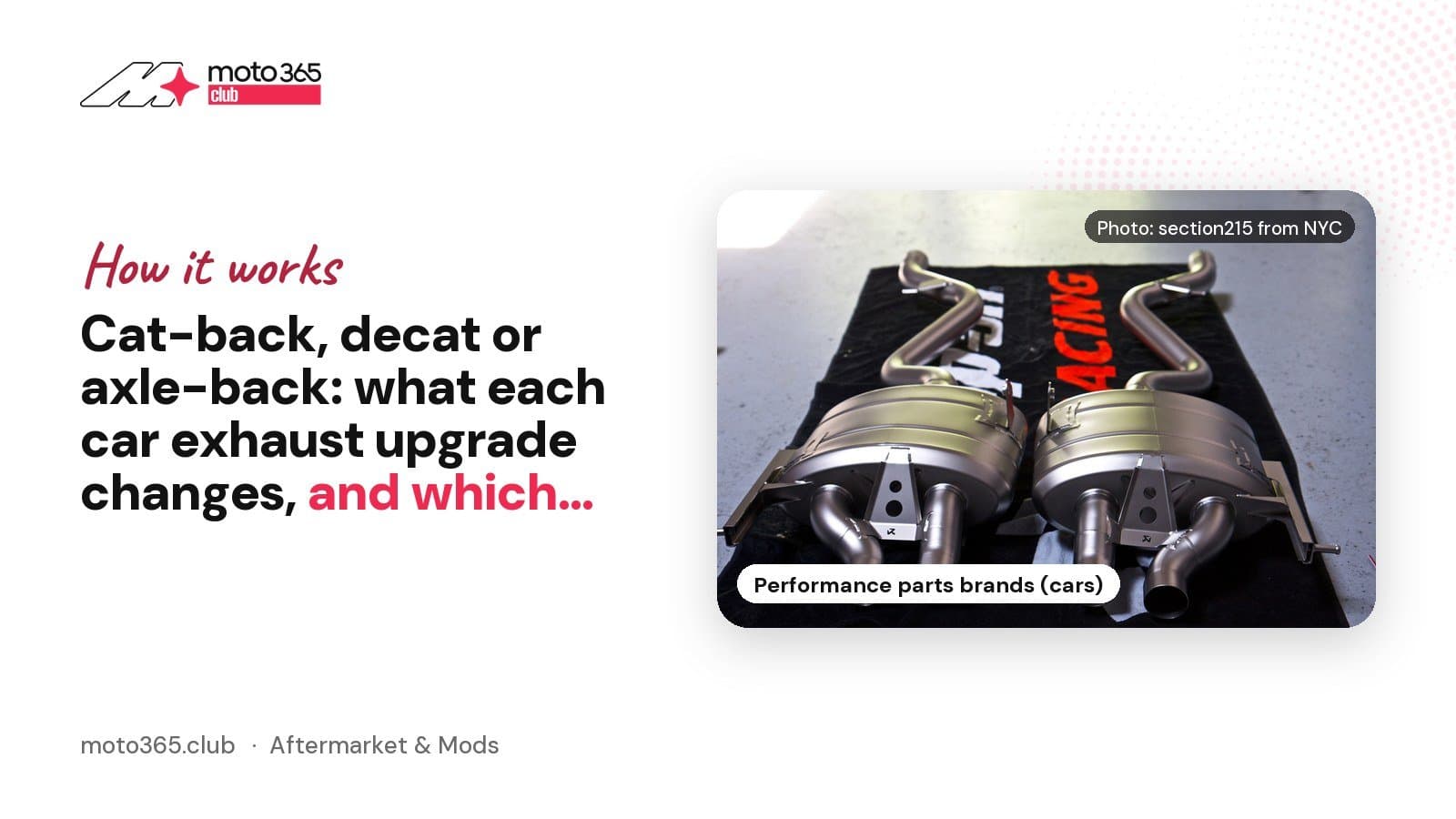 BMW M2
The short answer first. Of everything an exhaust brand will sell you, only the parts behind the catalytic converter can be fitted to a road car in India with a straight face, and even then only if the car does not get louder than the standard it was built to meet. A decat downpipe is sold by the brands themselves as an off-road and competition part. Fitting one to a car you drive on the road exposes you to a fine of up to ₹10,000 and a three month licence disqualification on a first offence.
What each part of the system actually does
Work backwards from the engine. First the manifold or header, then the downpipe, which on most turbocharged cars carries the main catalytic converter, then a mid-pipe that usually holds a resonator, then the rear muffler and tips.
An axle-back or slip-on changes only the last box. Akrapovič calls its version the Slip-On Line and designs it to bolt into the stock position. A cat-back replaces everything behind the converter, and Milltek says you do not need to change anything on the vehicle when fitting one. A turbo-back or header-back goes further forward and includes the downpipe, which Milltek notes may require ECU recalibration.
The resonator is the part that decides how you live with the car. Milltek describes a resonator as cancelling out certain frequencies, so a resonated system adds performance while minimally changing the exhaust note, and a non-resonated one is louder.
Then the fork in the road. A high flow sports cat, by Milltek's own claim, increases flow by as much as 30 per cent over the OE unit while keeping a catalytic converter in place. A decat removes it, and Milltek states plainly that its decat downpipes are sold for closed-course competition and off-road use only and are not street legal.
The gains from the legal route are real but modest. Akrapovič's Evolution Line for the 2017 BMW M2 is quoted at 6.8 kW more power at 6150 rpm and 8.8 Nm more torque at 4300 rpm, with 5.3 kg saved, which it puts at 24.4 per cent. That system is ECE approved under UN Regulation ECE-R59 for replacement silencing systems, and Akrapovič notes it does not fit cars with an Otto particulate filter. Variant matters as much as model.
Source: Akrapovičmoto365.club
What Indian law actually tests
Rule 120(1) of the Central Motor Vehicles Rules requires every motor vehicle to be fitted with a silencer that reduces the exhaust noise as far as practicable. Rule 120(2) says every vehicle must be constructed and maintained so as to conform to the noise standards in Part E of Schedule VI of the Environment (Protection) Rules, 1986. The word maintained is the one owners miss. The duty does not end at the factory gate.
Section 190(2) of the Motor Vehicles Act is the charge that follows. A first offence of driving a vehicle that violates the standards on control of noise and air pollution carries imprisonment up to three months, a fine up to ₹10,000 or both, plus a three month licence disqualification. A second offence doubles the jail term.
Section 52(1) is the other half. No owner may so alter a vehicle that the particulars in the registration certificate differ from those originally specified by the manufacturer, and an alteration made without the registering authority's approval has to be reported within 14 days. Separately, Rule 115 requires a pollution certificate once the car is a year old, with idling limits on carbon monoxide and hydrocarbons. The converter is the device that keeps those numbers in range.
How to buy one without trouble
Ask for paperwork before money. REMUS publishes downloadable approval certificates by vehicle, and Akrapovič states the regulation its approved systems are built to. An ECE approval is not Indian law, but a system engineered to a replacement silencer standard is a very different object from an unbranded straight pipe.
Match the part to your exact variant, including whether the car has a particulate filter. Keep the stock exhaust in a box, because a bolt-on cat-back is reversible and a cut-out converter is not.
Sources
- 1.Milltek Sport FAQs: cat-back, downpipes, de-cat and sports catmilltekcorp.com
- 2.Akrapovič Evolution Line (Titanium) for BMW M2 (F87) 2017akrapovic.com
- 3.Rule 120, Central Motor Vehicles Rules, 1989 (Silencers)indiankanoon.org
- 4.Section 190(2), Motor Vehicles Act, 1988indiankanoon.org
- 5.Section 52, Motor Vehicles Act, 1988 (Alteration in motor vehicle)devgan.in
- 6.Rule 115, Central Motor Vehicles Rules, 1989 (Emission standards)indiankanoon.org
- 7.REMUS approval certificatesremus-exhausts.com
Tagged models
More from Aftermarket & Mods
All stories
Is an aftermarket CNG kit legal in India? What RTO and insurer need
meera_mods2 hours ago · 3 min read

Is changing your car's colour with a wrap legal in India?
meera_mods16 hours ago · 3 min read
Slip-on or full system exhaust: which should you buy in India?
meera_mods1 day ago · 3 min read


Comments
Be the first to comment.