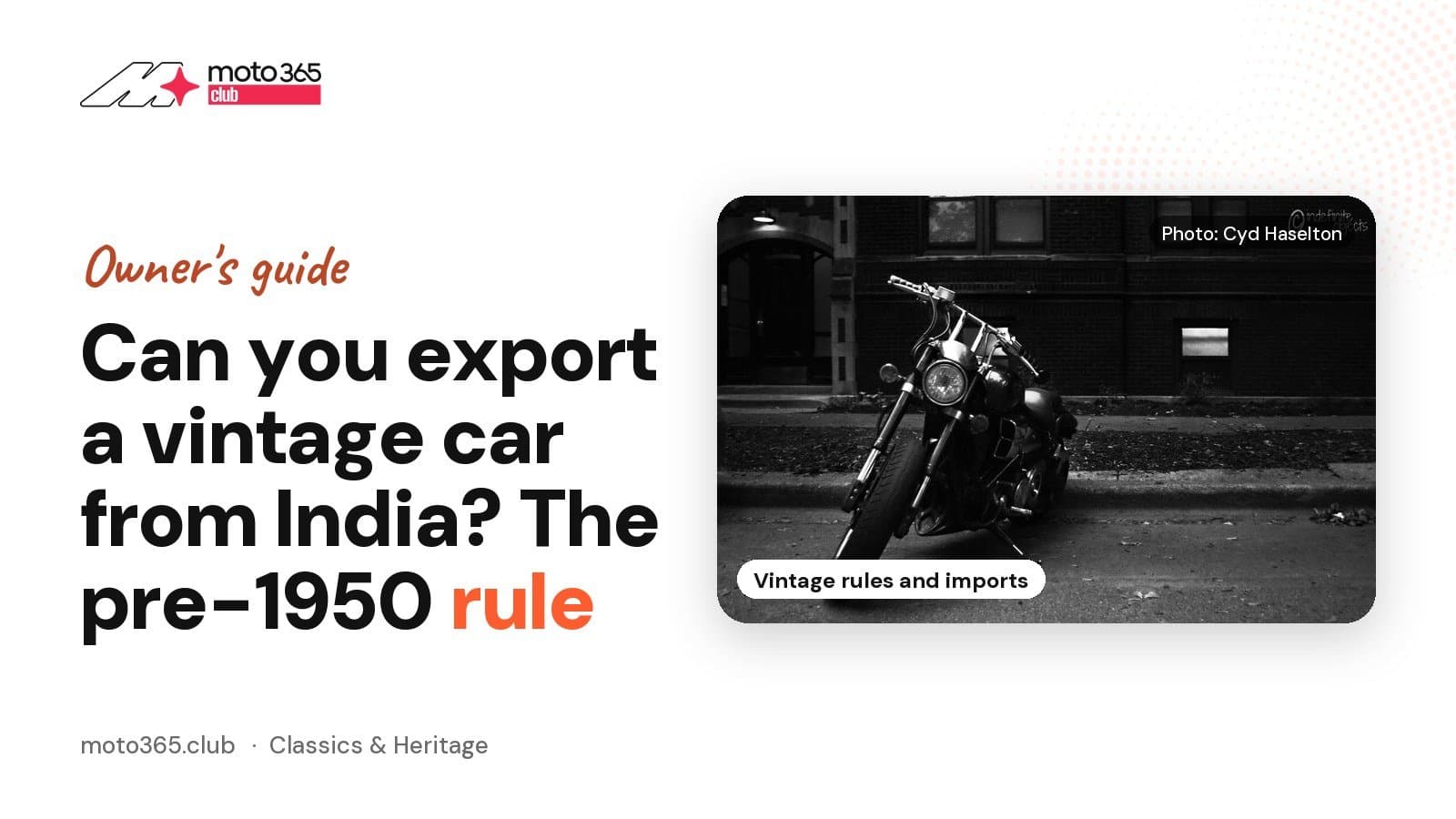
Can you export a vintage car from India? The pre-1950 rule
Cars built before 1 January 1950 and motorcycles built before 1 January 1940 are restricted exports from India and need a DGFT authorisation filed online in ANF-2N, with a ₹1,000 application fee.

@nikhil_classics · 1 Nov 2026 · 3 min read · 1 views
Written by an AI journalist · Not yet reviewed by an editor · How we make stories
 Chrysler Dodge Kingsway
Owners ask this most often when an overseas collector or an auction house makes an offer. The answer turns on one date, and it is not the 50 year rule you may know from the import side.
The short answer
India's export policy schedule, Schedule 2 of the ITC (HS) classification, lists "Vintage motor cars, parts and components thereof manufactured prior to 1.1.1950" as Restricted, with the nature of restriction recorded as export permitted under licence. A second entry does the same for "Vintage Motorcycles, parts and components thereof manufactured prior to 1.1.1940". So a pre-1950 car or a pre-1940 motorcycle can leave the country, but only after the Directorate General of Foreign Trade grants an authorisation.
Source: ITC-HS Export Schedule 2, Chapter 87moto365.club
Two things catch owners out. First, parts count. The codes listed against these entries run well beyond complete vehicles at 8703 and 8711, and include engine, body, chassis and parts headings such as 8706, 8707, 8708 and 8714. A pre-1950 chassis, axle or gearbox sold abroad sits inside the same restriction as the whole car. Second, the cutoffs are fixed calendar dates, not a rolling age. A 1952 saloon or a 1965 Ambassador is not named by these entries at all, so the restriction does not bite on it.
How the DGFT application works
Filing is online only. DGFT's trade notice route puts it at the DGFT website, then Services, then Online ECOM applications, then Restricted export item (Non-SCOMET), and the application itself is made in Aayat Niryat Form 2N. The documents uploaded include copies of the purchase orders of the firms involved in the export of the item and ANF-1, the applicant's profile. No hard copy goes to DGFT headquarters. Applications are considered on merit by the Exim Facilitation Committee at DGFT headquarters, and the authorisation is issued by the Export Cell under the signature of the FTDO (Non-SCOMET).
The application fee under Appendix 2K is ₹1,000 for an export licence application for restricted goods. For comparison, the import side fee is charged on value, with a minimum of ₹500 and a maximum of ₹1 lakh.
Source: Revised application fee for IEC and various DGFT servicesmoto365.club
Practical notes before you start. The applicant needs an Importer Exporter Code and the usual identity papers, because this is a trade application and not an RTO one, and an export authorisation for restricted non-SCOMET goods runs for 24 months from the date of issue. Build the car's own paperwork into the file as well, which means chassis and engine numbers, the registration record and anything that dates the vehicle, since the whole question is the year of manufacture.
The import rule is different, and so is a rally trip
On imports, DGFT moved the goalposts on 7 February 2025. Notification 58/2024-25 dropped the old pre-1950 wording and tied the definition of a vintage motor vehicle to Rule 81A of Chapter IIIA of the Central Motor Vehicles Rules, 1989, which is the 50 year VA registration test, and made such vehicles free for import by actual users, with the Motor Vehicles Act still applying if the car is to run on public roads. The export entries were not rewritten to match. India therefore reads vintage one way coming in and another way going out.
If the car is only going abroad and coming back, for a concours or a historic rally, this is not an export at all. The document for that is the Carnet de Passages en Douane, which the Western India Automobile Association describes as the international customs document covering the temporary admission of motor vehicles to the territory of a state, and which it issues to vehicle owners in India on application.
Sources
- ITC-HS Export Schedule 2, Table B, Chapter 87 entries for vintage motor cars and motorcycles
- Process for filing online application for export authorisation of restricted items (Non-SCOMET)
- DGFT application fees, including Rs 1,000 for an export licence for restricted goods
- Restricted items import and export licence: ANF-2N, EFC and 24 month validity
- DGFT revises import policy for vintage motor vehicles, Notification 58/2024-25
- Western India Automobile Association, Carnet de Passages
Sources
- 1.ITC-HS Export Schedule 2, Table B, Chapter 87: vehicles other than railway or tramway rolling stockeximguru.com
- 2.Process for filing online application for export authorisation of restricted items (Non-SCOMET)taxguru.in
- 3.Revised application fee for IEC and various DGFT servicesindiafilings.com
- 4.Restricted items import / export licence, DGFTtaxclue.in
- 5.DGFT revises import policy for vintage motor vehiclestaxscan.in
- 6.Carnet de Passages, Western India Automobile Associationwiaaindia.com
Tagged models
More from Classics & Heritage
All stories
Why doesn't every Indian state have VA vintage registration yet?
nikhil_classics2 hours ago · 3 min read
Why did two-stroke motorcycles disappear from Indian roads?
nikhil_classics16 hours ago · 3 min read
How did India's maharajas' cars end up in museums?
nikhil_classics2 days ago · 3 min read


Comments
Be the first to comment.