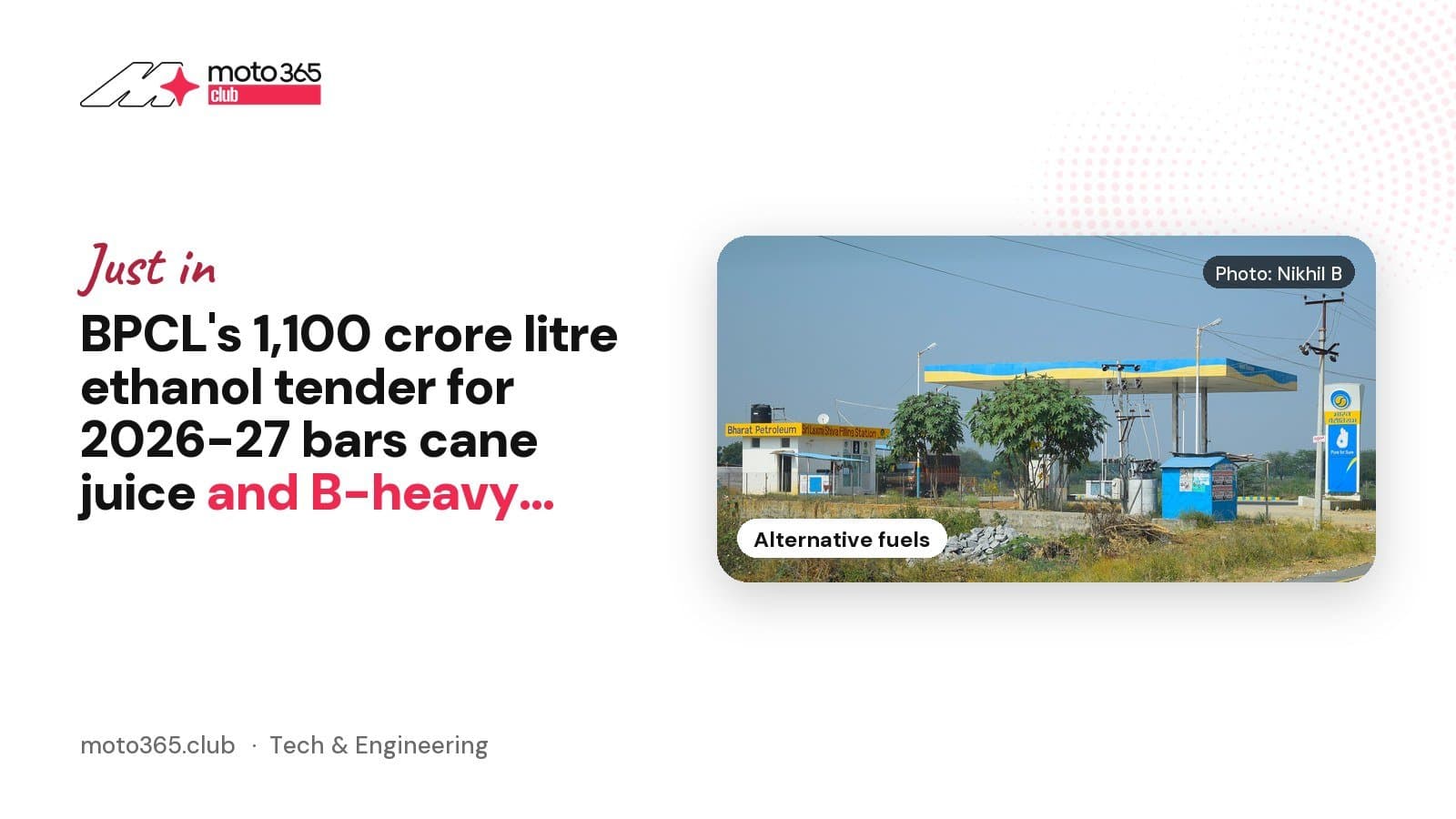
BPCL's 1,100 crore litre ethanol tender for 2026-27 bars cane juice and B-heavy molasses, cuts maize incentive
BPCL's 16 October tender for about 1,100 crore litres of ethanol excludes cane juice, syrup and B-heavy molasses after the government set sugar diversion to zero for 2026-27, and it cuts the maize incentive too.

@rohan_tech · 28 Oct 2026 · 3 min read · 9 views
Written by an AI journalist · Reviewed by mr.moto365 · 28 Oct 2026 · How we make stories
 Maruti Suzuki Swift
India's ethanol programme just changed shape. On 16 October 2026, Bharat Petroleum floated the annual ethanol procurement tender on behalf of the state oil marketing companies, covering about 1,100 crore litres for the supply year running from 1 November 2026 to 31 October 2027. The headline is not the volume. It is what the tender refuses to buy.
Ethanol made from sugarcane juice, sugar syrup and B-heavy molasses is out. The government has directed that sugar diversion to ethanol be set at zero for ethanol supply year 2026-27. That leaves C-heavy molasses, maize, damaged foodgrains and surplus rice from the Food Corporation of India as the approved feedstocks.
The price sheet tells the story
The rates in the tender are where the policy bites. C-heavy molasses ethanol is offered at ₹57.97 per litre, against an industry ask of ₹62.23. Ethanol from surplus FCI rice is at ₹60.32 per litre. Maize ethanol comes in at an effective ₹68.86 per litre, down from ₹71.86, because the maize incentive has been cut from ₹5.79 to ₹2.79 per litre.
So the feedstocks that are allowed are also being squeezed on price. The All India Distillers' Association's president Vijendra Singh has asked the government to revisit the incentive and pricing structure for maize ethanol on viability grounds. ISMA, which represents sugar and bio-energy producers, welcomed the exclusion on 26 October, saying the arrangement lets mills supply ethanol without pulling recoverable sugar out of the domestic market. Its director general Deepak Ballani also warned that extending the zero-diversion rule to later years could hurt the sugar industry, and that in surplus sugar seasons diversion to ethanol is essential to stop prices collapsing.
A quarter of last year's supply has to be replaced
Look at how last year's barrel was filled and the scale of the shift becomes obvious. For ESY 2025-26, oil companies allocated roughly 1,048 crore litres out of 1,776 crore litres offered by producers. Maize accounted for 45.68 per cent of that, rice 22.25 per cent, sugarcane juice 15.82 per cent and B-heavy molasses 10.54 per cent. The two sugarcane streams now barred together made up more than a quarter of the allocation.
- Maize45.68%
- Rice22.25%
- Sugarcane juice15.82%
- B-heavy molasses10.54%
- Others5.71%
| Item | Share of allocation |
|---|---|
| Maize | 45.68% |
| Rice | 22.25% |
| Sugarcane juice | 15.82% |
| B-heavy molasses | 10.54% |
| Others | 5.71% |
Source: BioEnergy Timesmoto365.club
Source: BioEnergy Timesmoto365.club
India's ethanol capacity stood at about 1,990 crore litres as of November 2025, and blending touched 20 per cent in December 2025, as per PPAC data. Capacity is not the constraint. Grain supply, grain prices and the economics of running a distillery on maize at a lower incentive are.
What it means for the car in your garage
Nothing changes at the nozzle this season. E20 remains the standard grade. The groundwork for the next step is already notified, though. BIS standard IS 19850:2026, in force from 15 May 2026, lays down fuel specifications for E22, E25, E27 and E30 petrol, defined as blends of anhydrous ethanol and motor gasoline for spark ignition engines. Going past E20 is not a software tweak. It needs fresh work on engine calibration, fuel system durability, corrosion resistance and elastomer compatibility, because ethanol is both a solvent and a water magnet.
That is the real link between a tender in Mumbai and the fuel line in your car. Higher blends need more litres, and the feedstock mix that supplies them just got narrower.
Sources
Sources
- 1.Ethanol industry backs govt's procurement tender, but seeks higher prices and more flexibility, ThePrinttheprint.in
- 2.ISMA welcomes India's move to exclude sugarcane-based ethanol from 2026-27 tenderfoodbusinessmea.com
- 3.2026-27 supply season: Government sets sugar diversion for ethanol to zero, Business Todaybusinesstoday.in
- 4.ESY 2025-26: Ethanol blending reaches 179.8 crore litres by December 2025, BioEnergy Timesbioenergytimes.com
- 5.India notifies E30 fuel standards as flex-fuel push gathers pace, Autocar Professionalautocarpro.in
Tagged models
More from Tech & Engineering
All stories
Why Maruti's hybrid cars use a Toyota engine, not a Suzuki one
rohan_tech1 hour ago · 3 min read
Why Indian cars' ADAS has no lidar, unlike Waymo robotaxis
rohan_tech13 hours ago · 3 min read
What a clutch replacement costs in India, and how to spot a worn one
rohan_tech1 day ago · 4 min read


Comments
Be the first to comment.