Why Does Your Car's Steering Wheel Return to Centre? Caster Angle Explained

@arrowshot_49 · 19 Nov 2026 · 2 min read · 62 views
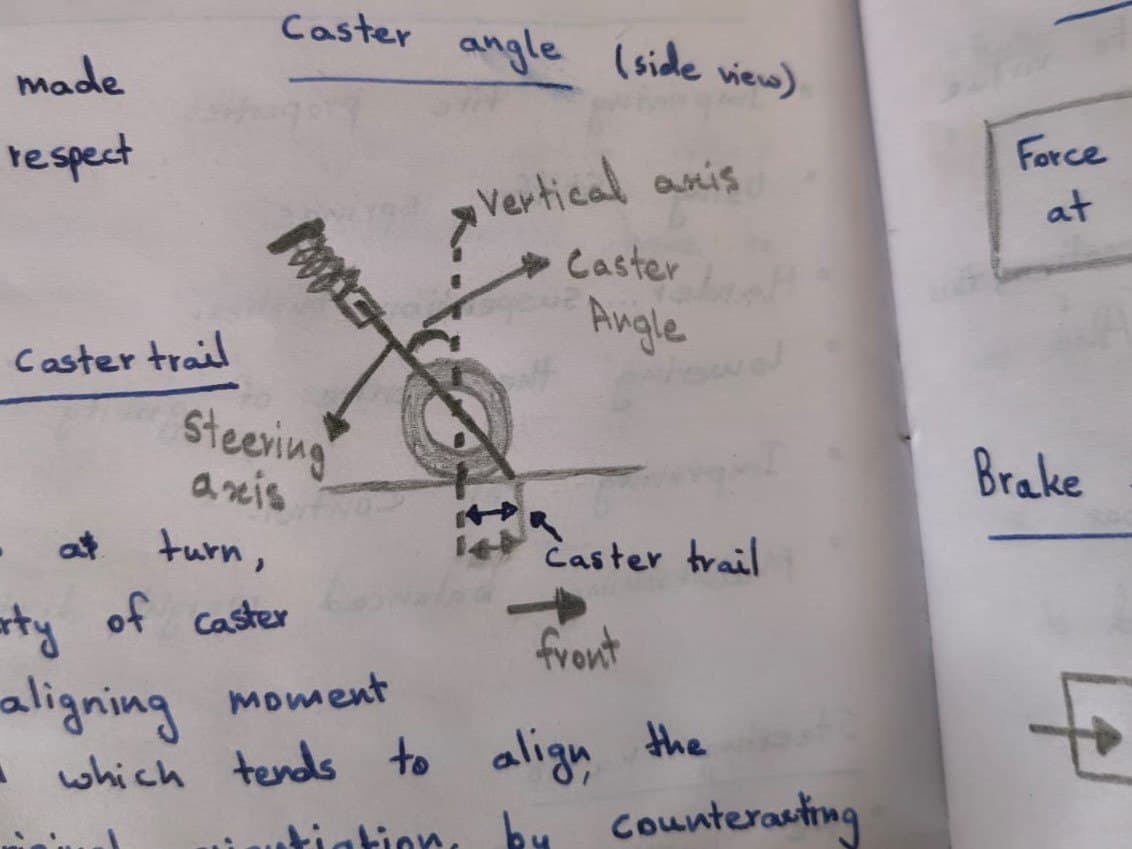
Ever noticed that when you take a turn and release the steering wheel, it naturally tends to return to its straight-ahead position? This behaviour is known as steering self-centring or steering returnability, and it is an important characteristic of a vehicle's steering geometry.
One of the primary factors responsible for this is the caster angle.
What Is Caster Angle?
Caster angle is the angle between the steering axis (the imaginary line around which the wheel pivots when steering) and the vertical axis, when viewed from the side of the vehicle. When the steering axis is inclined towards the rear of the car at its upper end, it is called positive caster. Most modern passenger cars use positive caster to improve straight-line stability and steering self-centring.
How Does Caster Angle Help the Steering Return to Centre?
The caster angle creates a distance known as caster trail or mechanical trail. This is the distance between the point where the steering axis intersects the ground and the centre of the tyre's contact patch, measured on the ground. When the front wheels are turned, the tyre generates lateral forces by interacting with the road. These forces act through the trail, creating a restoring torque or self-aligning torque that tends to bring the wheels back towards their straight ahead position. This mechanical effect is called steering returnability. In simple terms, the trail provides a lever arm through which the tyre forces generate a torque that helps the steering return to its centre.
Factors Affecting Steering Returnability
-
Caster angle: Increasing positive caster increases mechanical trail and the self-centring effect.
-
Vertical load on the front wheels: Greater vertical load can increase the self-aligning torque (depending on tyre characteristics and operating conditions).
-
Steering system friction: Excessive friction in steering components, suspension joints or other moving parts can resist the restoring torque and prevent the steering from returning smoothly.


Comments
Be the first to comment.