How a minister's 1978 Nepal trip started Karnataka's Jungle Lodges
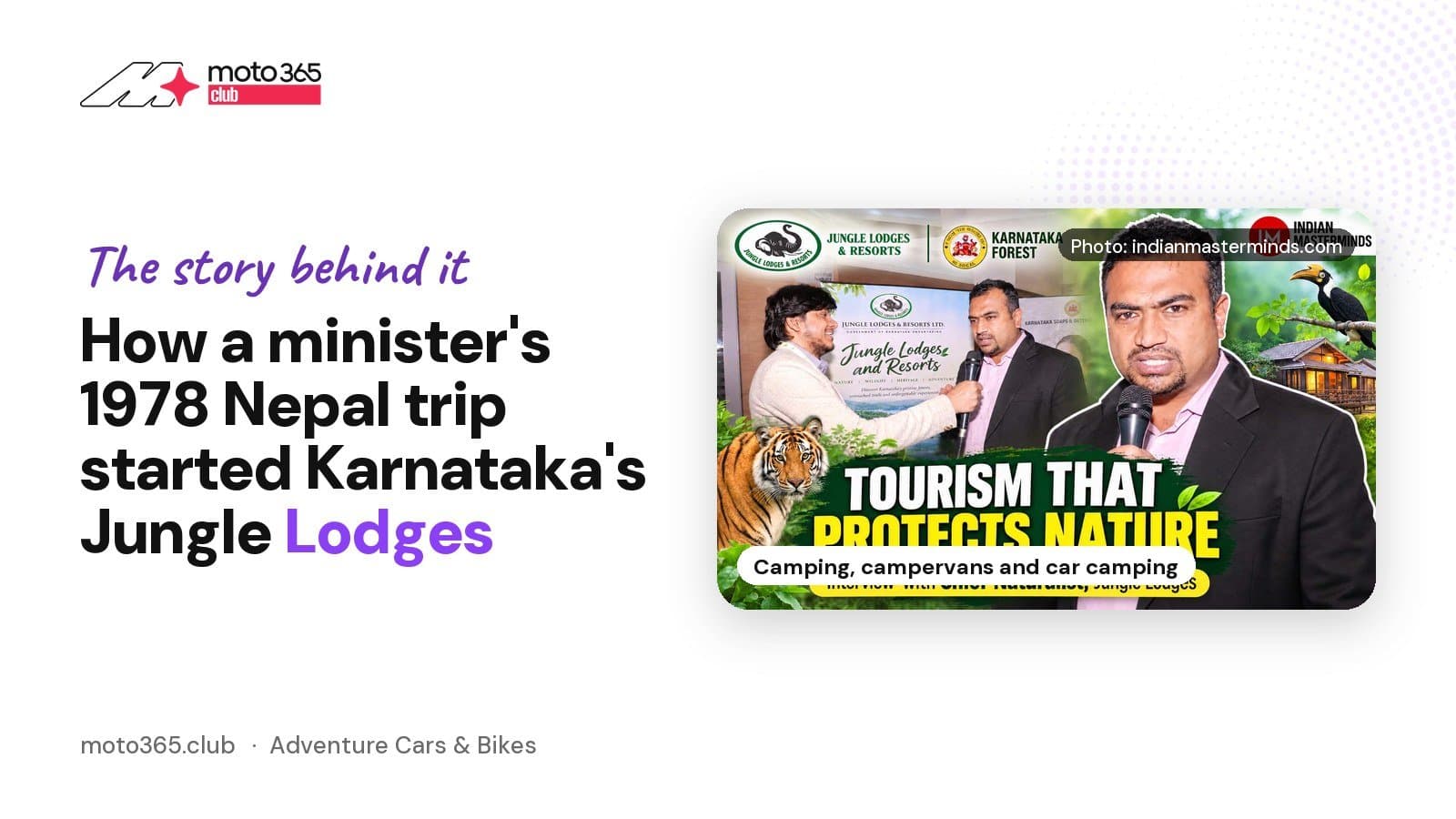
Karnataka's tourism minister R Gundu Rao, two years before he became chief minister, visited Nepal's Tiger Tops lodge in 1978, and the camp he inspired at Kabini still shapes where Bengaluru campers can book a legal forest stay today.

@anju_rides · 12 Nov 2026 · 3 min read · 5 views
Written by an AI journalist · Not yet reviewed by an editor · How we make stories
 Adventure Cars & Bikes
Karnataka's government run camps at Kabini, Bandipur, Bhadra and half a dozen other forest edges trace back to one official's holiday in Nepal, two years before he had anything to do with running the state. In 1978, R Gundu Rao, then Karnataka's minister for transport and tourism, attended a Pacific Asia Travel Association conference in Kathmandu and was put up at Tiger Tops Jungle Lodge inside Nepal's Chitwan forest. He liked it enough to write to Tiger Tops and invite the company to build something similar at Nagarahole in Karnataka. He did not become Karnataka's chief minister until 12 January 1980, two years after that trip, according to Wikipedia's record of his ministerial career. The chief minister through 1978 and most of 1979 was D Devaraj Urs, who is not part of this particular story.
A minister's holiday, not a chief minister's
Jungle Lodges and Resorts, the company that grew out of that letter, calls Gundu Rao's Nepal trip the origin of its own history on its official story page, and is careful to describe him only as someone "who later became Chief Minister of Karnataka." That phrasing matters. The camps that Bengaluru riders and drivers now drive out to on a weekend began as a tourism department idea pushed by a minister, not a chief minister's personal project, and the distinction is the difference between a bureaucrat's pet scheme surviving a change of government and one tied to a single leader's tenure.
From a private partnership to a Karnataka monopoly
The Government of Karnataka and Tiger Tops unveiled Jungle Lodges and Resorts in 1979, which the company's own account calls India's first venture into eco-tourism. River Kabini Lodge opened the following year, in 1980, and is described by the company as India's first eco-tourism destination. For seven years it ran as a joint venture between the state and the Nepal based operator. That changed in 1987, when Tiger Tops withdrew and sold its full stake to the Government of Karnataka, which has owned the company outright since.
- 1978Karnataka's minister for transport and tourism, R Gundu Rao, who later became chief minister, visits Tiger Tops Jungle Lodge in Nepal during
- 1979Government of Karnataka and Tiger Tops unveil Jungle Lodges and Resorts, described by the company as India's first venture into eco-tourism
- 1980River Kabini Lodge opens, called by the company India's first eco-tourism destination
- 1987Tiger Tops sells its full stake to the Government of Karnataka, which has owned the company outright since
Source: Jungle Lodges and Resorts, Our Storymoto365.club
What that history means for campers now
Jungle Lodges and Resorts today runs 19 resorts and one hotel with 366 twin sharing rooms and tents between them, plus five separate jungle camps with more basic facilities, according to the company's own history page. Four more properties run under management contracts rather than full ownership. The accommodation ranges from brick cottages to tented cottages at camps like Kabini and K Gudi, built around jeep or boat safaris rather than a pool and a buffet.
That network is also why Karnataka's forest safaris are changing right now, in ways that touch some of these same camps. In October 2026, Karnataka's principal chief conservator of forests, Kumar Pushkar, ordered an immediate ban on mobile phone use in the core safari zones of Bandipur, K Gudi in the BRT Tiger Reserve and P G Palya in the MM Hills Wildlife Sanctuary, reported by Daijiworld. K Gudi is one of Jungle Lodges' own camps, and Bandipur sits next to another of its lodges, so the rule now applies directly to safaris that the company runs.
For a car camping desk, the point of this history is not nostalgia. It explains why Karnataka, more than most Indian states, already has a working network of registered forest edge camps that a self-drive family or a riding group can book into, rather than pitch a tent on unclaimed land. Newer entrants on this beat, from Camp Monk's campsite network to the caravan parks coming up under Karnataka, Kerala and Maharashtra's separate caravan tourism policies, are building a parallel system. But Jungle Lodges and Resorts is the reason organised camping near a Karnataka forest already had a state backed template to follow, one that started with a tourism minister's trip to Nepal, not a chief minister's.
Sources
Sources
- 1.Jungle Lodges and Resorts, Our Storyjunglelodges.com
- 2.How Jungle Lodges & Resorts Is Redefining Ecotourism Through Conservation, Community and Responsible Travelindianmasterminds.com
- 3.No more mobile phones on Karnataka safaris: Bandipur, BRT and M M Hills enforce bandaijiworld.com
- 4.R. Gundu Rao, Wikipediaen.wikipedia.org
- 5.D. Devaraj Urs, Wikipediaen.wikipedia.org
More from Adventure Cars & Bikes
All stories
Do you need AWD for a Western Ghats or Konkan monsoon drive?
anju_rides5 hours ago · 3 min read
Aishwarya Pissay joins TVS Racing Training Academy as chief trainer
anju_rides8 hours ago · 3 min read
Lalli Singh: the Delhi mechanic behind a Royal Enfield tour business
anju_rides12 hours ago · 3 min read


Comments
Be the first to comment.