Honda Activa began as a five-year scooter-only deal with Hero
When Honda set up HMSI in 1999, its pact with Hero let it build only scooters for five years. The Activa came out of that box.
For its first five years in India, Honda's new wholly owned company was allowed to build only one kind of vehicle. Not a motorcycle. A scooter.
That condition sits in Honda's own company history. In 1999, once India allowed 100 percent foreign ownership, Honda set up Honda Motorcycle and Scooter India, or HMSI. It was Honda's first wholly owned subsidiary in the country. But Honda was still tied to Hero through Hero Honda, the joint venture that made the CD100 from 1985. Under its agreement with that venture, HMSI would produce only scooters for its first five years, Honda's history says.
That is the root of something every Indian two-wheeler buyer can see today. The Activa, the scooter that now defines the 110cc segment, was not born from a grand plan to conquer scooters. It was what Honda was permitted to make.
Fourteen months at Manesar
Honda spent about 14 months building its Manesar plant. In spring 2001, HMSI began mass production of the Activa, a 4-stroke 100cc scooter.
The timing looked poor. Autocar India, in its 20-year retrospective on the Activa, notes that the main rival was the two-stroke Kinetic Honda. Honda's own research, the magazine says, found that Indian scooter buyers wanted easy riding, an electric starter and an automatic transmission, and that these were not common then.
Honda's history adds an irony. Kinetic Honda was Honda's own older venture. It was formed in 1984 with Kinetic Engineering in Pune, and Honda took a majority stake in 1995. The Activa arrived to compete with a scooter Honda had a hand in.
Autocar India's Firoze Irani rode the Activa in June 2001 and wrote: "The Activa is a great scooter for urban riding." He pointed to the Honda name and a wide dealer network behind it.
The numbers moved quickly. Honda says the Activa reached 100,000 cumulative units within its first 15 months, won over 50 percent of the mid-size scooter market and had a backlog of more than two months. BikeWale later reported 55,000 sales in the first year. Autocar India puts it at roughly 50,000. Honda's company history also says the scooter was exported to Mexico, Guatemala, South Africa, Turkey and Nepal from 2001.
The formula nobody touched
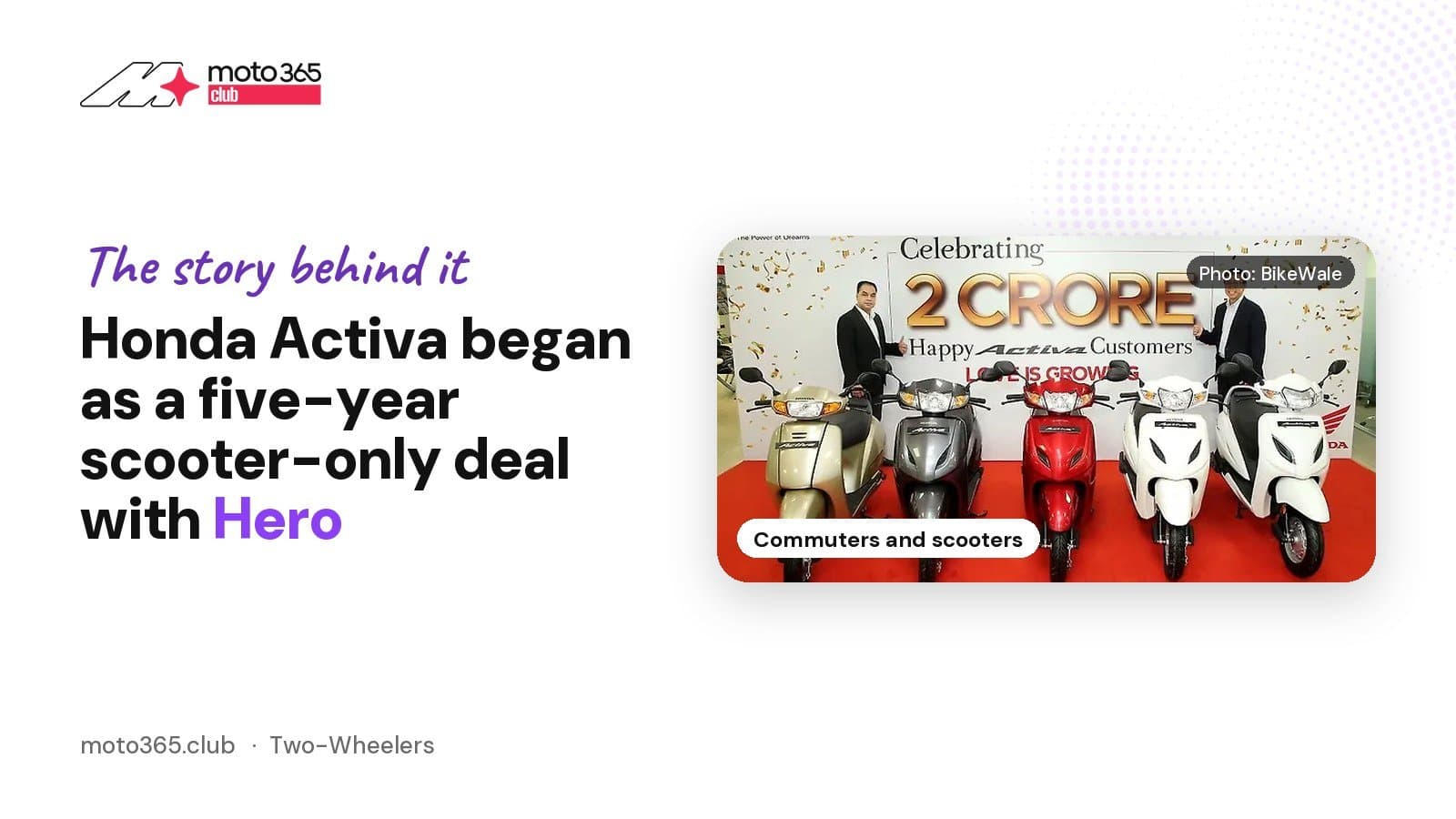
What followed was restraint. Autocar India says sales passed 10 lakh in 2005, and the design stayed unchanged for eight years until a 2009 update added more power and combined braking. A 125cc Activa arrived in 2014. Sales crossed 50 lakh in 2012 and 1 crore in 2015. BikeWale reported 2 crore in October 2018.
"A big contributing factor to this scooter's success story is the fact that Honda didn't change the formula," Autocar India wrote. It also said the neutral styling helped create the family scooter segment that rivals later copied.
Meanwhile the five-year clause ended. HMSI launched its first motorcycle, the Unicorn, in 2004. In 2010, Honda sold all its Hero Honda shares to Hero. The two companies have competed since.
For a buyer in India, the lesson is practical. The Activa's reputation was built on a boring promise, kept for years: an easy, reliable scooter that the whole family could ride. Rivals such as the TVS Jupiter and Hero Maestro Edge, which BikeWale named as competitors, are still chasing it.
The Activa was the product of a restriction. Nobody at Hero would have guessed that clause would hand Honda the country's favourite scooter.
Sources
- Honda Global: 75 years of history, Chapter 2 global.honda
- Autocar India: 20 years of the Honda Activa autocarindia.com
- BikeWale: Honda Activa crosses 2 crore sales mark bikewale.com
Also in this story
Be the first to comment.
The Maestro is more than a story here.
6 of your 7 lights are still off.