EU committee votes 48 to 30 to soften 2035 car CO2 target to 95%
Low-carbon steel credits could drag Europe's "100% cut" to 87.5%, and the full Parliament and member states have not yet spoken.
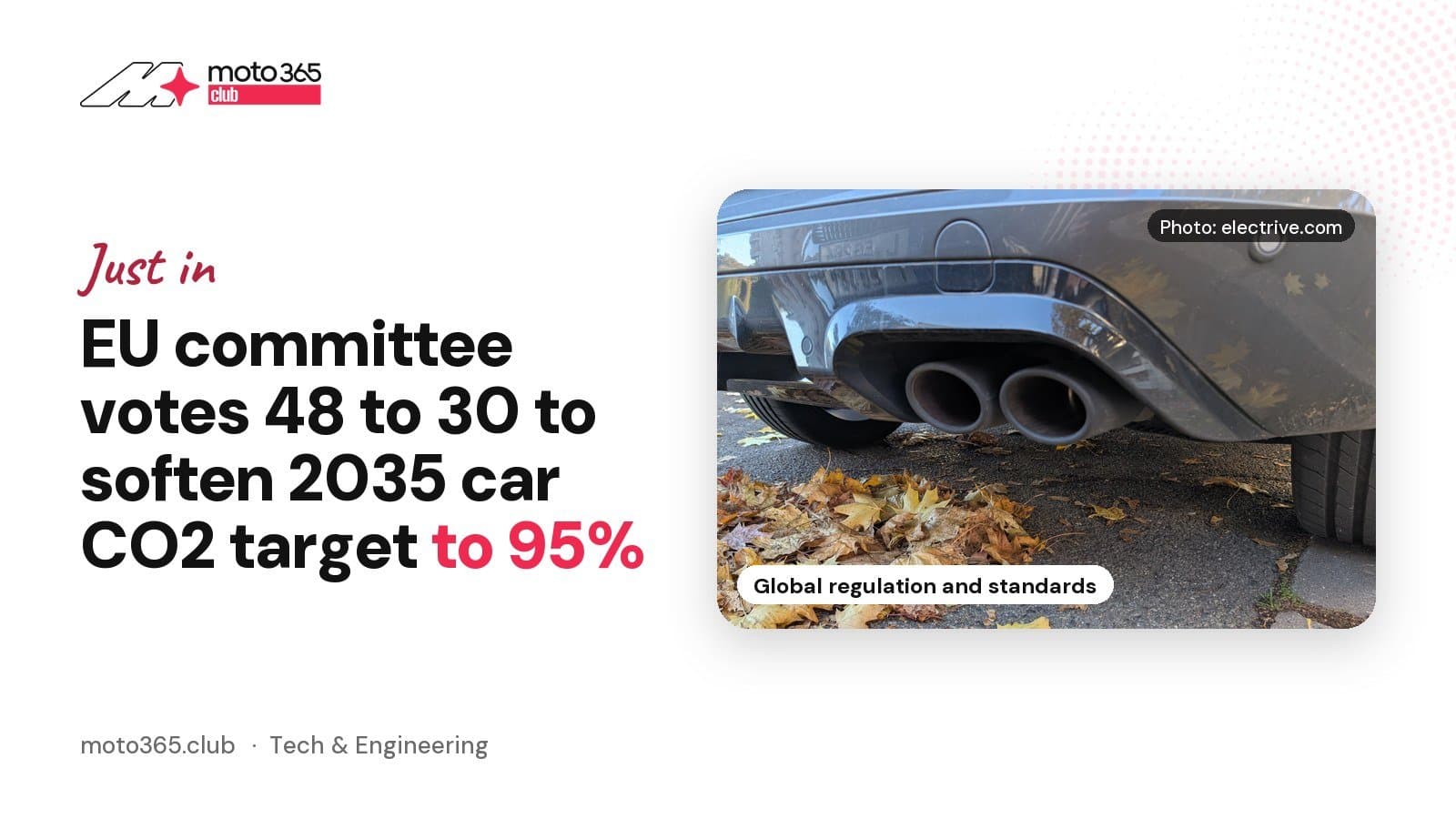
On Wednesday 4 November, the European Parliament's Environment Committee voted 48 to 30, with two abstentions, to change what "zero emissions by 2035" means for a new car. The old rule said 100% less CO2 than 2021. The committee's text says 95%, and a credit for low-carbon steel could take the real figure down to 87.5%.
The vote, reported by electrive, is not law. The full Parliament is expected to decide in December. EU governments in the Council must then agree, and that needs a qualified majority of at least 15 countries representing at least 65% of the EU population.
Here is how the arithmetic works. Carmakers would cut fleet CO2 by 95% against 2021 levels. They could claim up to 7.5 percentage points more from low-CO2 steel made in Europe, which is how the worst case reaches 87.5%. Before 2035, steel credits would be capped at 3 percentage points, counted from the day the regulation enters into force until the end of 2034.
Vans get a softer path. The 2030 van target would be 35%, against 40% in the Commission's draft and 50% under current rules. For 2035, vans would need 80%, with the same steel credit.
Fuels are the second opening. Massimiliano Salini, the Italian EPP MEP who led the negotiation, said vehicles running exclusively on renewable fuels that meet the Renewable Energy Directive would be recognised as emission-free. Under the draft, new combustion and hybrid vehicles could still be registered after 2035. "Decarbonisation does not mean prescribing a single technology," Salini said, as quoted by electrive.
The Commission's own proposal had asked for a 90% cut, with full compensation for the remaining 10% through green steel and cleaner fuels. Electrive also notes that Germany and France have proposed a 90% cut by 2035 without compensation.
The politics split cleanly. Peter Liese, the EPP's climate spokesperson, said: "We want climate neutrality, but with the rules we have now agreed on, we are also ensuring technology neutrality." Michael Bloss, a German Green MEP, called the vote a "bad deal" for the European car industry. Both statements are reported by Euronews.
For readers in India, nothing here binds an Indian showroom. India writes its own fuel economy and emission norms. But Europe is the reference market for many global platforms, and Indian suppliers and carmakers that build for Europe plan around what it requires. The text also shows a big regulator trading a hard powertrain target for credits on materials and fuels. Indian carmakers and policymakers arguing over how to credit hybrids and alternative fuels face a similar question.
Nothing is settled. The 100% target in current law stays in force until Parliament and the Council reach a deal. Next comes the December plenary, then the Council, where Germany and France have already put a different 90% number on the table.
Sources
Be the first to comment.
The Club is more than stories.
6 of your 7 lights are still off.